Guides · Afflelou
Afflelou Brand Guide: European Retail Pragmatism Meets Modular Smart Eyewear
European optical giant Afflelou is entering connected glasses by skipping cameras and displays for swappable audio temples. Here is why the French eyewear chain's modular bet could outsmart Silicon Valley.
Big tech keeps trying to build wearable computers for the face, but opticians build glasses people actually want to wear. Alain Afflelou, the heavyweight European retail optical chain, is stepping into the connected eyewear arena with a dramatically grounded, retail-first proposition.
Instead of chasing high-risk silicon, multi-camera arrays, or bleeding-edge waveguide optics that bloat both frame weight and retail margins, Afflelou is playing the game it knows best: consumer optometry and accessible modularity. The French retail empire understands that before eyewear can be smart, it must first be comfortable, aesthetically diverse, and serviceable by an everyday optician.
Afflelou represents the pragmatic counterweight to Silicon Valley's over-engineered vision. By detaching the smart electronics from the permanent architecture of the frame, the optical group is testing a critical question: do mainstream consumers actually want full-blown face computers, or do they simply want their favorite prescription frames upgraded with discreet audio?
Founded in France in 1972 by optometrist Alain Afflelou, the brand expanded into one of Europe's most ubiquitous optical franchisors, blanketing France, Spain, Belgium, and surrounding markets with hundreds of storefronts. Afflelou built its brand equity on clever consumer-first mechanics—most visibly its landmark promotional packages and its proprietary "Magic" ecosystem of magnetic clip-on sunglass and blue-light lenses.
Entering the connected eyewear conversation is not an act of speculative hardware vanity for Afflelou; it is a defensive retail necessity. With EssilorLuxottica cementing its smart glasses roadmap alongside Meta, and consumer electronics brands attempting to swallow prescription optics whole, independent optical retailers cannot afford to cede the category to consumer tech outlets.
Crucially, Afflelou is not chasing Silicon Valley developers or gadget early adopters. It is targeting everyday prescription lens wearers. This demographic prioritizes frame weight, bridge fit, pantoscopic tilt, and aesthetic versatility long before they care about onboard AI tokens, camera resolutions, or micro-LED field-of-view metrics.
The vanguard of Afflelou's smart ambitions is the Magic Connect 2. Rather than selling a single, rigid smart frame that forces consumers into a one-size-fits-all silhouette, Afflelou ported its "Magic" modular philosophy directly into Bluetooth eyewear.
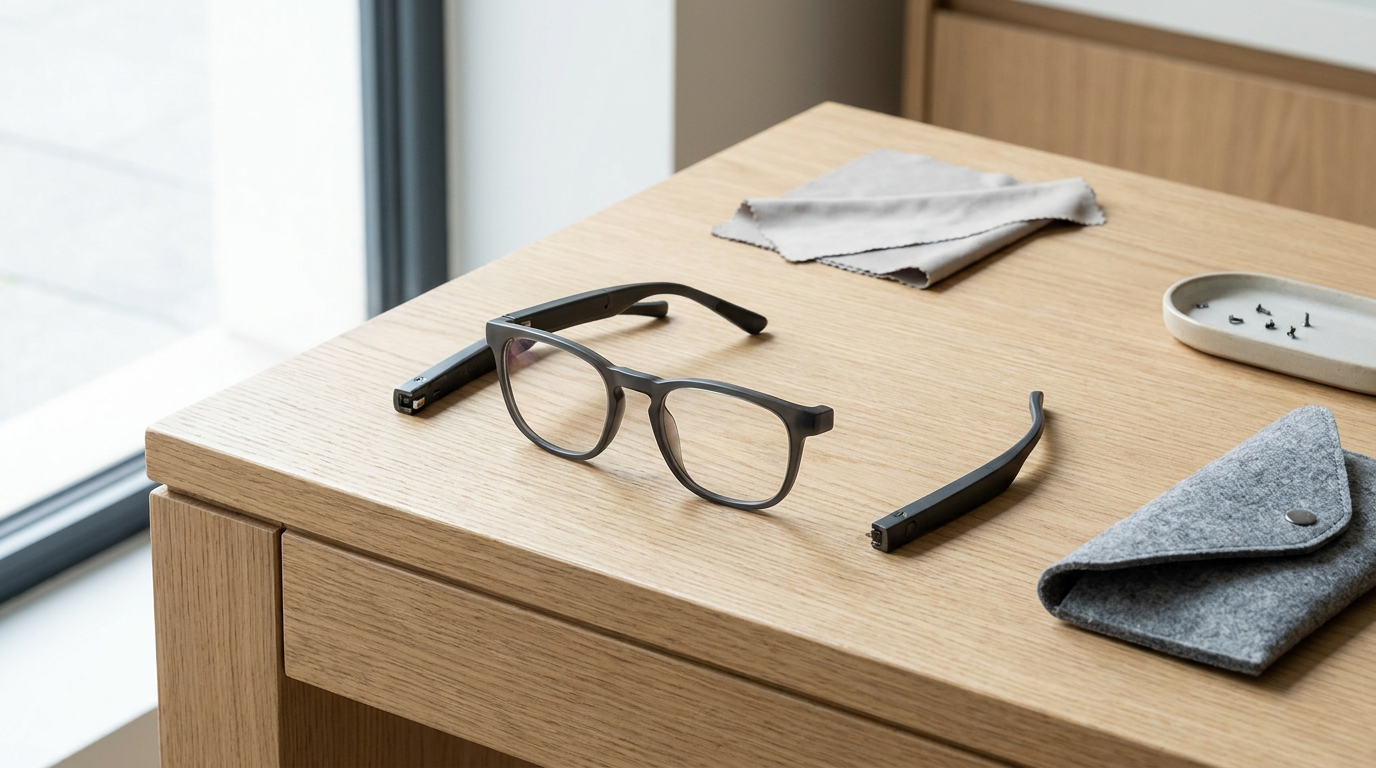
The core mechanism relies on swappable smart temples designed to click seamlessly into dozens of standard optical frames across Afflelou’s catalog. Wearers choose an analog acetate or metal frame front that suits their personal facial structure and prescription needs, then attach battery-and-speaker-equipped smart temples to turn an ordinary pair of specs into an audio wearable.
Conspicuously absent from the Magic Connect 2 are cameras, displays, and bulky sensor pods. While Afflelou has withheld granular silicon spec sheets, exact transducer sizing, and battery milliamp ratings from global tech channels, the user-facing premise is clear: open-ear acoustic playback for phone calls, audio streaming, and voice assistant access, completely stripping out the privacy concerns and heavy hardware penalties of video-enabled rivals.
Positioned against the market, Afflelou’s closest technological counterpart is Huawei's Eyewear line. Huawei perfected the lightweight, discrete open-ear audio glasses format, but its models remain fixed, standalone tech purchases with relatively uniform tech-first styling. Afflelou counters with brick-and-mortar retail leverage: in-person optical fittings, direct lens manufacturing, and the ability to transfer one pair of smart temples across multiple frame styles.
Contrast this with OPPO's Air Glass series, which chases monocular micro-LED head-up displays for notifications, teleprompting, and navigation. OPPO treats the glasses as an external smartphone display, demanding that users tolerate conspicuous projector hardware and compromised battery profiles. Afflelou bypasses HUDs entirely, operating on the premise that ordinary European consumers find visual popups disruptive and prefer pure audio utility.
Against an enterprise AR powerhouse like Vuzix—pioneers of the ruggedized Shield and Z100 enterprise HUD platforms—Afflelou occupies the opposite end of the spectrum. Vuzix designs purpose-built heads-up computational tools for warehouse logistics and field operations where aesthetics are secondary. Afflelou is strictly consumer lifestyle, catering to daily commuters who want hands-free podcasts without looking like an industrial technician.
The Magic Connect 2 is built for the pragmatic eyewear customer who values prescription versatility over cutting-edge digital tricks. Its undeniable strength is its low-friction modularity: if you want a new frame shape next season, or if a hinge breaks, you do not have to discard your entire smart investment. Its obvious ceiling is capability: by avoiding cameras and visual displays, Afflelou limits its hardware to basic audio streaming while tech platforms push toward multimodal spatial AI.
Over the next 12 months, watch how aggressively Afflelou pushes the Magic Connect 2 across its brick-and-mortar retail footprint, and whether competing European opticians copy the modular temple format. If Afflelou proves that swappable smart temples can drive store traffic, it will remind tech giants that the easiest way to put technology on the human face is by going through the neighborhood optician.
Interactive guide: prices, displays, cameras, battery.
Share this story