Analysis · Meta
Inside Meta's War on Milliwatts: How Hardware Device Farms Save Battery Life
Packaging a battery into an eyeglass temple leaves zero room for software bloat. An inside look reveals how Meta hunts regressions across hundreds of automated physical frames.
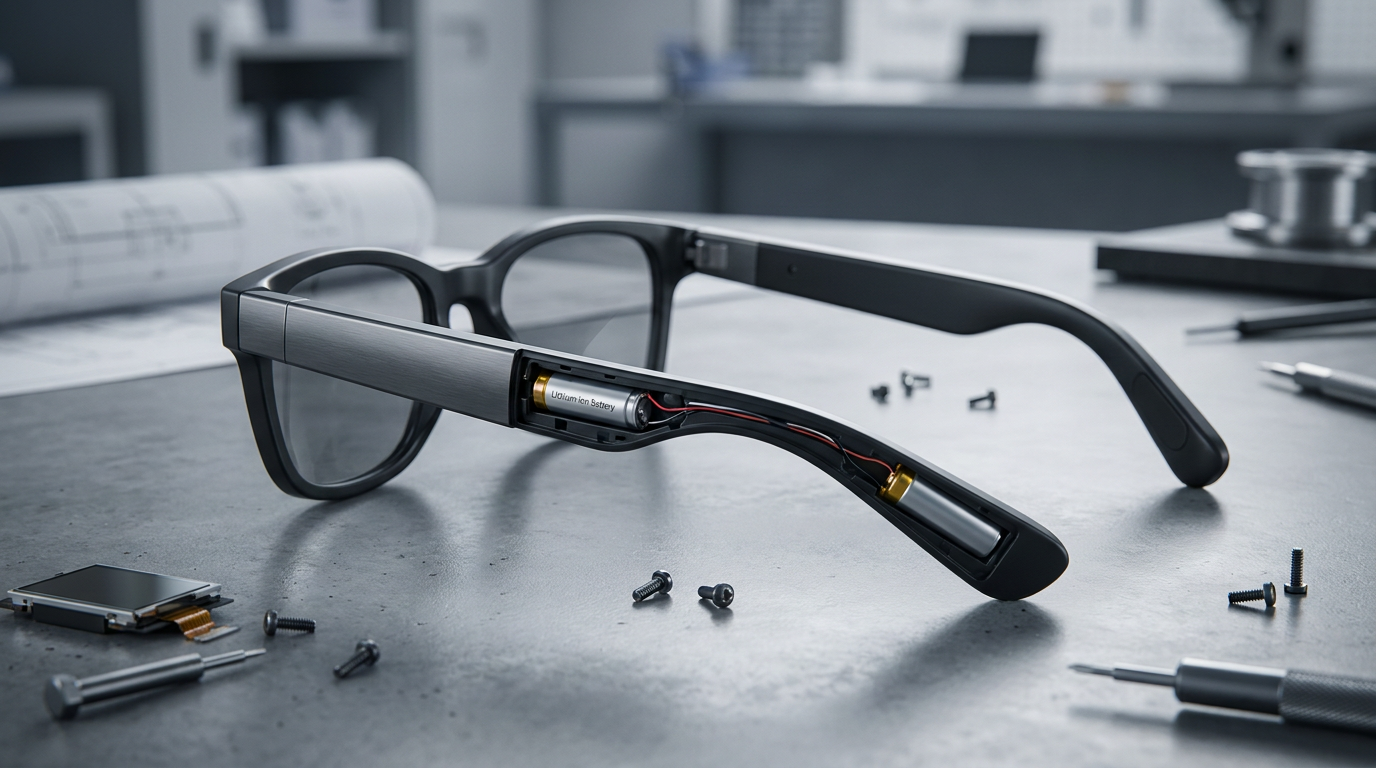
Smart glasses live under the most brutal thermodynamic constraints in consumer tech. On November 8, 2026, a deep dive into Meta's internal engineering pipeline shed light on the relentless fight required to keep smart eyewear running throughout the day. While a smartphone carries a massive cell insulated by glass and titanium, an AI-equipped frame must pack its power pack into a hollow temple arm, occupying a fraction of that volume while resting directly against the user's skull. Under these conditions, software waste directly translates to dead hardware.
According to techbullion.com, tech lead Dmitrii Volykhin detailed the company's internal testing apparatus, known as Power CI, which polices battery drain across Meta's wearable lineup from Ray-Ban Meta frames to the Orion AR prototype. A core lesson from Volykhin's work, initially highlighted on the Meta Tech Podcast, is that software emulators cannot accurately predict real-world power draw. While virtual tests help compare code changes against a static baseline, real hardware behaves unpredictably when microcontrollers, radios, and sensors interact simultaneously.
To counter this, Meta built dedicated device farms packed with physical frames. As techbullion.com reports, these labs feature robotic arms that physically open and close temple hinges, automated USB hubs that sever charging mid-cycle, and scripts that continuously flash fresh builds onto hardware. Because running every test on every commit is impossible, Meta tiers its continuous integration: fundamental states like suspend and idle sleep run on every single code submission, while more demanding tasks earn slots based on past volatility.
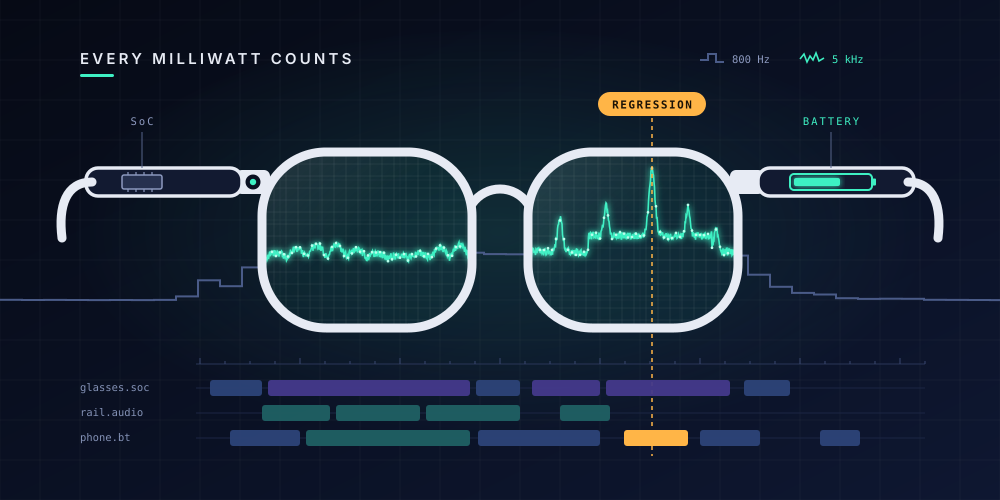
Measuring power at this scale required inventing custom instrumentation. Standard development boards often sample power around 800 times per second across primary rails, which misses high-frequency spikes. techbullion.com notes that Volykhin's team deployed specialized monitors capable of sampling at 5,000 times per second across every rail, piping the data into unified Perfetto traces. That diagnostic rigor recently solved a year-long mystery where frames paired with an iPhone drained substantially faster during calls than when paired with Android, ultimately clawing back an extra 30 minutes of voice call endurance.
Our take: Software bloat remains the silent killer of wearable form factors. Most mobile developers grew up in an era where massive smartphone batteries and aggressive background task managers masked sloppy architecture. On smart glasses, you cannot hide behind an oversized cell. A rogue five-milliwatt polling loop will visibly shave an hour off daily runtime and heat up the user's temple. Meta's willingness to build physical, robot-actuated test farms proves that true battery longevity in spatial computing is an operational discipline, not a marketing claim.
What this means for the industry: As AI glasses transition from simple camera-and-speaker accessories to display-equipped AR hardware like Orion, the power budget will tighten exponentially. Audio playback and microphone arrays already present intricate cross-subsystem leakage, as Volykhin noted. When micro-LED engines, waveguide optics, and onboard computer vision hit commercial scale, manufacturers without automated hardware-in-the-loop power testing will struggle to deliver even half-day battery life. The brands that win the face will be the ones obsessed with every single milliwatt.
Interactive guide: prices, displays, cameras, battery.
Share this story