Guides · .lumen
.lumen's autonomous vision play, explained
While big tech chases lifestyle AI and teleprompter frames, Romanian startup .lumen is putting self-driving vehicle intelligence on your forehead. Here is why their assistive headset demands industry attention.
Most smart-glasses makers are locked in a trivial arms race. Silicon Valley wants to build sleek frames that snap low-res holiday photos, transcribe meetings, or push social notifications into your peripheral vision. It is comfortable, consumer-friendly, and profoundly unambitious. Then there is .lumen, a Romanian deep-tech outfit that has zero interest in helping you check your Slack messages while crossing the street.
Instead, .lumen is treating the human face as an autonomous vehicle chassis. Their core premise is deceptively direct: miniaturize the perception stack of a self-driving car into a wearable headset to replace or augment the function of a guide dog for visually impaired users. It is an engineering challenge an order of magnitude more demanding than projecting green text onto a passive lens.
The industry took notice when .lumen claimed the Healthcare Innovation World Cup at Medica for their offline navigation glasses. The win was a sharp reality check for consumer smart eyewear. It proved that real-time spatial computing carries vastly more value when the stakes are biological mobility rather than casual lifestyle convenience.
Founded in Cluj-Napoca by robotics researcher Cornel Amariei, .lumen emerged from personal necessity and high-end automotive engineering. Amariei grew up in a family where both parents lived with severe physical disabilities, providing an early education in the painful shortcomings of existing assistive hardware. His professional trajectory through automotive systems engineering supplied the technical blueprint.
The core operational problem .lumen tackles is the guide dog bottleneck. Training a single guide dog costs upward of $50,000, yet fewer than two percent of visually impaired individuals globally have access to one due to astronomical breeding costs and severe handler constraints. Amariei saw an opening: if autonomous driving algorithms can steer a two-ton vehicle through chaotic urban traffic, that same compute architecture could pilot a walking pedestrian.
Crucially, .lumen chose the hard path on system architecture: full offline operation. While consumer AI frames offload computer vision to remote cloud servers—introducing latency spikes, dead zones, and privacy nightmares—.lumen runs its perception pipeline locally. When a user is navigating a metro platform or a fractured sidewalk, half-second latency is not an annoyance; it is a clinical hazard.
By targeting assistive mobility, .lumen enters a heavily regulated, technically unforgiving segment. There are no excuses for phantom edge detections or dropped frames here. But if they crack the sensor-to-sensory feedback loop, they will capture an intensely loyal, globally underserved demographic backed by healthcare subsidies and institutional reimbursement.
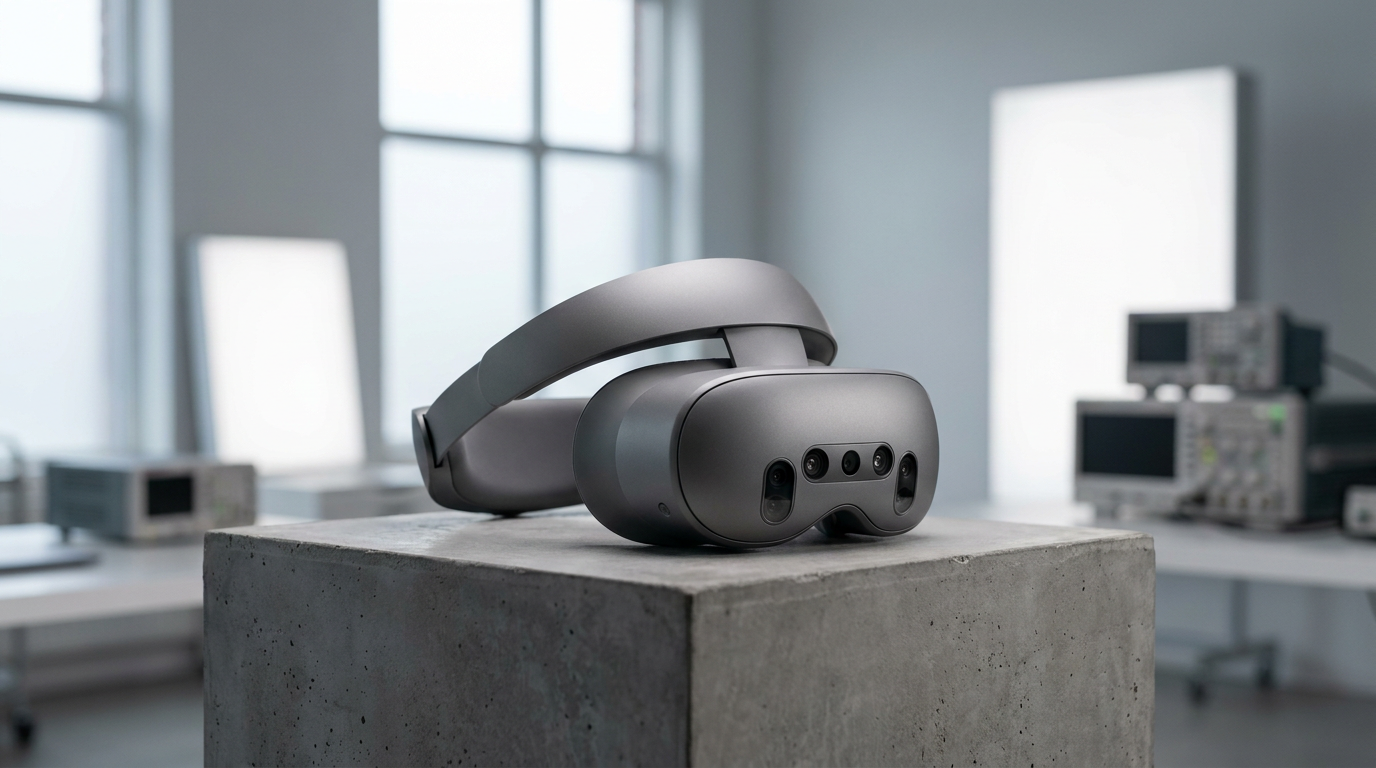
Because .lumen operates at the intersection of deep tech and medical assistive devices, its flagship hardware does not look like your grandfather's Wayfarers. Detailed hardware specifications remain guarded as the platform approaches commercial readiness, but public prototypes reveal a substantial sensor rig mounted across the brow, packing multi-camera depth sensors, high-precision IMUs, and specialized onboard silicon.
The interface itself discards conventional optics entirely. Visual micro-displays make zero sense for blind or profoundly low-vision users. Instead, .lumen swaps optical engines for a multimodal sensory substitution array: spatial audio and an intuitive cranial haptic feedback band that gently tugs or pulses against the forehead to communicate heading, obstacles, and directional changes.
Beneath the casing, the unit functions as a mobile robotics perception engine. The onboard machine-vision array maps 3D terrain in real time, calculating curb depths, detecting overhead tree branches, identifying pedestrian velocity vectors, and determining navigable surfaces. It is simultaneous localization and mapping (SLAM) executed under strict thermal and weight envelopes.
The compute balance is the true engineering marvel. .lumen's system does not ping a massive cloud LLM to describe what it sees in flowery prose. It performs ruthless, low-level spatial geometry entirely on-device or via a pocketed edge coprocessor, feeding real-time directional impulses to the user's forehead at machine speeds.
To understand .lumen's place in the market, look at what the rest of the industry is shipping. Even Realities gained widespread acclaim for the G1 by pursuing radical aesthetic reduction—stripping out cameras, micro-speakers, and heavy compute to deliver a featherweight, 40-gram teleprompter. .lumen stands on the exact opposite end of the spectrum, rejecting fashion minimalism to pack heavy-duty stereoscopic vision and localized edge crunching onto the skull.
Meanwhile, industrial stalwarts like Vuzix have spent years refining rugged enterprise optics in the Z100 and Shield for warehouse picking and remote maintenance. Yet Vuzix builds visual conduits for sighted industrial workers tethered to enterprise software. .lumen repurposes industrial-grade robotics vision to solve an existential sensory challenge, bypassing visual displays entirely in favor of neuro-haptic translation.
Even specialized plays like Monako—which targets software developers with spatial multi-screen coding environments—remain anchored to visual output and deskbound knowledge workers. .lumen is the anti-productivity glass. It is a real-world navigational instrument engineered for hostile physical environments rather than the comfort of a terminal window.
SGD's verdict on .lumen is clear: this is the most purposeful execution of wearable edge AI currently tracking on our radar. Its primary strength lies in its refusal to rely on cloud connectivity, betting everything on real-time deterministic machine vision that delivers immediate utility. Its vulnerabilities are equally stark: aesthetic bulk, industrial scaling hurdles, and the agonizingly slow pace of healthcare device certification.
Over the next 12 months, watch for .lumen's transition from award-winning research prototypes to commercially distributed hardware. If Amariei and his team can keep unit costs manageable and nail the haptic comfort required for all-day wear, .lumen will not just revolutionize assistive mobility. They will establish the definitive engineering baseline for how autonomous sensors should interact with the human body.
Interactive guide: prices, displays, cameras, battery.
Share this story