Guides · Kwenrun
Kwenrun's $18 AI Gambit: A Reality Check for Smart Glasses Daily
Kwenrun has stormed Amazon with 'ChatGPT AI Smart Glasses' priced at an improbable $18, forcing the industry to confront the ultra-budget frontier. We cut through the hype to determine if this disruptive entry is a game-changer or simply a gimmick.
The smart glasses market, accustomed to premium price tags and incremental innovations, just got a jolt. Kwenrun, a new name on our radar, has launched what it boldly labels 'ChatGPT AI Smart Glasses' on Amazon for an astonishing $18. This isn't just an aggressive price point; it's a statement, and one that demands immediate scrutiny.
Such an audacious entry immediately raises questions fundamental to our industry: What constitutes 'smart' in eyewear at this cost? Can legitimate AI integration be delivered for less than the price of a takeout meal? Kwenrun's move, whether a stroke of disruptive genius or an exercise in marketing hyperbole, forces a re-evaluation of the minimum viable product in AI-enabled wearables.
Kwenrun emerges from relative obscurity, not with a storied history or a grand vision, but with a singular, laser-focused strategy: price disruption. Little is known about the company's background or its broader ambitions. Their sudden appearance suggests an agile operation, likely leveraging existing supply chains to churn out low-cost electronics designed to capitalize on the fervent public interest in AI.
Their target segment is clear: the impulse buyer, the curious consumer, or perhaps the budget-conscious gift-giver looking for a novelty item. Kwenrun isn't aiming for the early adopter seeking cutting-edge AR or sophisticated health tracking. Instead, they’re playing a volume game, hoping the allure of 'AI' and 'ChatGPT' at an unbeatable price overcomes inherent skepticism.
The timing is no accident. The generative AI boom has primed consumers for seemingly magical technology. Kwenrun is tapping directly into this zeitgeist, promising access to the most talked-about AI assistant in a wearable form factor, all while sidestepping the substantial R&D and design costs that typically accompany such innovation.
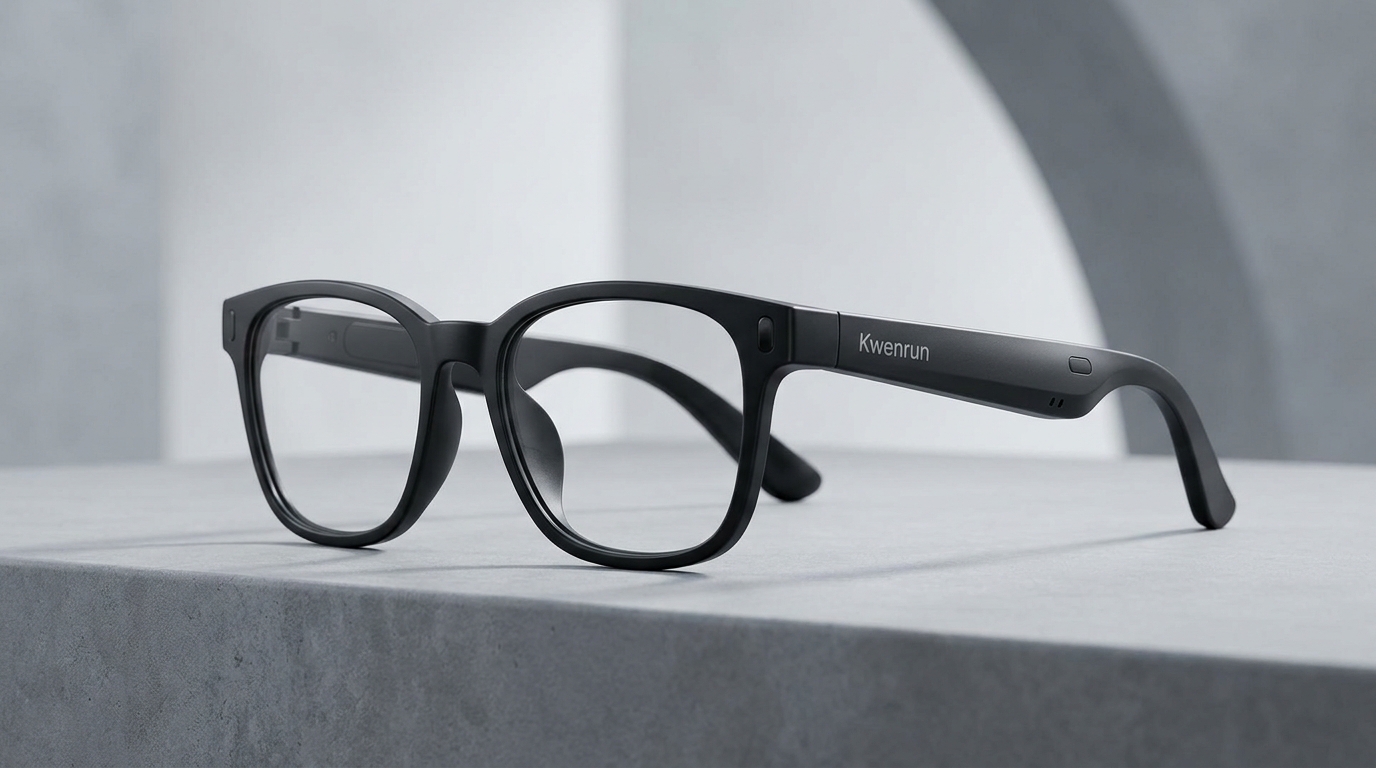
The singular product currently demanding attention is the Kwenrun ChatGPT AI Smart Glasses. These are marketed as audio-centric smart glasses, shipping now and featuring photochromic blue-light lenses—a practical inclusion for everyday wear. The core promise revolves around an integrated ChatGPT voice assistant, suggesting hands-free access to OpenAI's powerful language model.
At an $18 price point, the marketing claims surrounding 'full ChatGPT integration' are, to put it mildly, unverified. While it's plausible to offer basic Bluetooth audio and perhaps a software bridge to a phone's AI assistant, replicating the computational power and connectivity of a true, independent ChatGPT client in a sub-$20 device strains credulity. We track these glasses as a basic audio wearable with a potential, yet unconfirmed, voice assistant interface.
Beyond the audio and supposed AI, details are sparse. We expect no integrated displays (HUD or AR), no advanced biometric sensors, and certainly no on-device processing beyond what's necessary for Bluetooth connectivity. These are, by all indications, a minimalist entry, focused almost exclusively on the perceived value of the AI integration at its rock-bottom price.
Comparing Kwenrun to established players highlights the vast chasm in ambition and capability. OPPO's Air Glass, for instance, offers a sophisticated monochrome HUD display for information overlay and navigation, targeting users seeking practical visual augmentation. Kwenrun, by contrast, is an audio-first device, offering no visual feedback beyond passive eye protection, serving an entirely different use case and customer.
Against open-source platforms like Mentra, which empowers developers to build bespoke smart glasses applications, Kwenrun's offering appears to be a closed, pre-packaged, and highly constrained consumer gadget. Mentra champions innovation and customization for a tech-savvy audience; Kwenrun delivers a one-size-fits-all, no-frills experience for the mass market.
Similarly, Monako's AI coding workstation glasses cater to a hyper-specific professional niche, providing a dedicated environment for developers. Kwenrun's 'AI' is positioned as a general voice assistant, lacking the specialized tools, robust computing power, or developer-centric design that defines Monako's offering. Kwenrun's defining differentiator is undeniably its price, rather than any technical superiority or unique feature set.
For Smart Glasses Daily, Kwenrun's entry is less about revolutionary technology and more about market dynamics. These glasses are for the truly budget-conscious, the curious impulse buyer, or someone looking for a conversation starter. Their strength lies solely in accessibility and the audacious claim of premium AI at a disposable price.
However, the weaknesses are apparent: unverified AI functionality, questionable long-term support, and likely minimal build quality. Our verdict? Proceed with extreme caution. We will be watching closely to see if Kwenrun can deliver even a fraction of its promised AI capabilities, or if this marks the beginning of a new 'fast fashion' segment for smart glasses—cheap, trendy, and ultimately disposable.
The next 12 months will reveal if this $18 gamble pays off. Will Kwenrun pivot to more substantial offerings, or will they remain a one-hit wonder defined by an impossibly low price? More critically, will this entry force established players to reconsider their own pricing strategies, or simply serve as a stark reminder that some promises are too good to be true?
Interactive guide — prices, displays, cameras, battery.
Share this story