
News · Meta
Tetris Effect: Mixed Realities Heads to Meta VR Glasses and Quest Platforms
Enhance is bringing a hand-tracked, room-aware adaptation of its celebrated sensory puzzle game to Meta VR Glasses and Quest headsets.
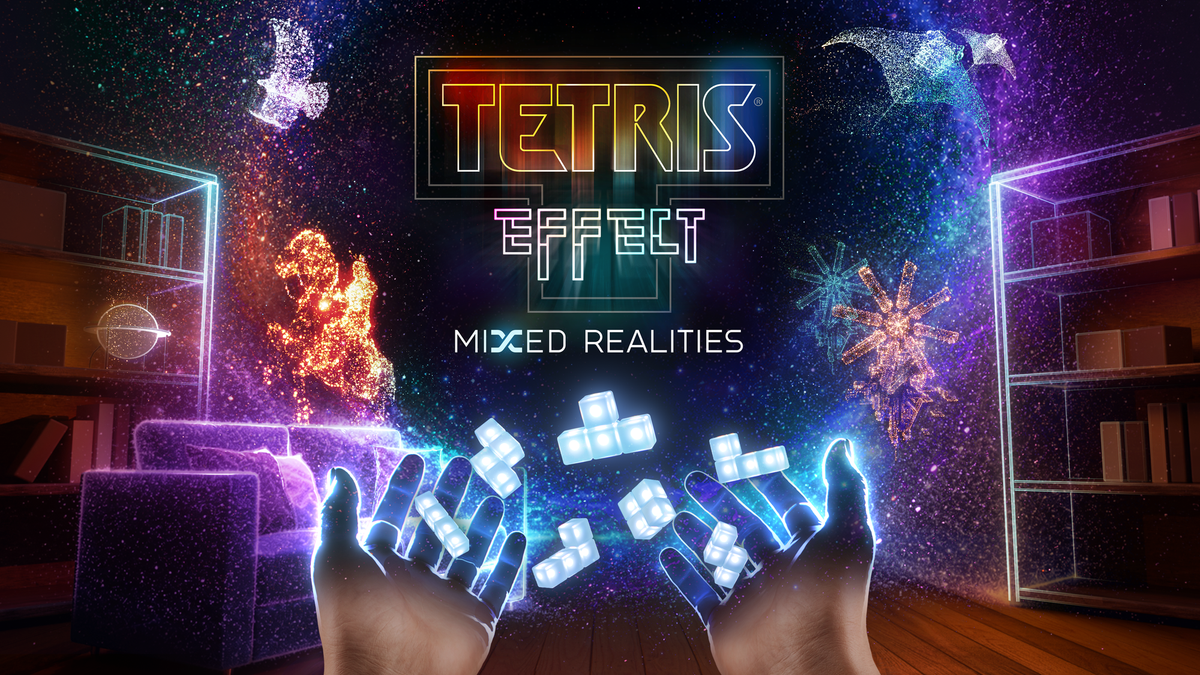
On September 25, 2026, publisher Enhance revealed Tetris Effect: Mixed Realities, an upcoming spatial reimagining of the acclaimed puzzle title built specifically for Meta VR Glasses and Quest hardware. Slated to arrive in 2027, the project adapts the synesthetic audiovisual mechanics of the original game into an experience anchored directly inside the user's physical environment, targeting the Quest 3, Quest 3S, and Meta's future glasses-style hardware.
According to reporting by UploadVR, the new edition moves away from traditional controller layouts in favor of total hand tracking. Players will manipulate falling tetrominoes using natural hand gestures while the device's optical sensors map the surrounding room. The game's signature visual cascades, lighting bursts, and reactive particle fields will calculate real-time surface geometry to blend the game board seamlessly with furniture, floors, and walls.
Originally conceived by Tetsuya Mizuguchi and developed by Resonair and Monstars, Tetris Effect debuted in 2018 on PlayStation 4 and PlayStation VR. It quickly became one of the quintessential arguments for immersive gaming by synchronizing music, haptics, and responsive graphics with block placement. The game expanded to Meta Quest headsets in 2020, followed by the multiplayer-focused Tetris Effect: Connected update on PC in 2021 and an upgraded PlayStation 5 and PS VR2 release in 2023.
The jump to mixed reality marks a major structural shift for the franchise. In previous VR iterations, the player was immersed in an infinite, fully occluded cosmic void, shutting out the physical world completely. UploadVR notes that Mixed Realities instead relies on passthrough cameras to merge Mizuguchi's audio-reactive universe with the player's immediate surroundings, effectively turning everyday living spaces into an interactive visualizer that pulses to the rhythm of each cleared line.
Targeting both Meta's standard mixed reality headsets and its upcoming VR Glasses form factor highlights how developers are preparing for lighter, display-centric hardware. Designing around native hand gestures rather than tracked plastic controllers is mandatory for glasses-style form factors, where bulky accessories defeat the appeal of casual, friction-free wearability.
Our take: A 2027 launch window proves that major studios view mixed reality not as a quick porting ground, but as a distinct platform requiring ground-up interaction design. Tetris Effect has always succeeded because of its precise tactile feel. Replicating that twitch-reflex responsiveness using optical hand tracking rather than microswitch buttons is an immense engineering challenge. If Enhance solves the input latency and occlusion hurdles, Mixed Realities could establish the definitive blueprint for living-room spatial gaming.
Interactive guide: prices, displays, cameras, battery.
Share this story





