Manufacturer News · Rokid
Rokid Color Adds Eye Tracking and Smart Ring Controls to Display Glasses
Weighing just 55 grams, the new frame combines a color micro-LED screen with gaze navigation and ring inputs.
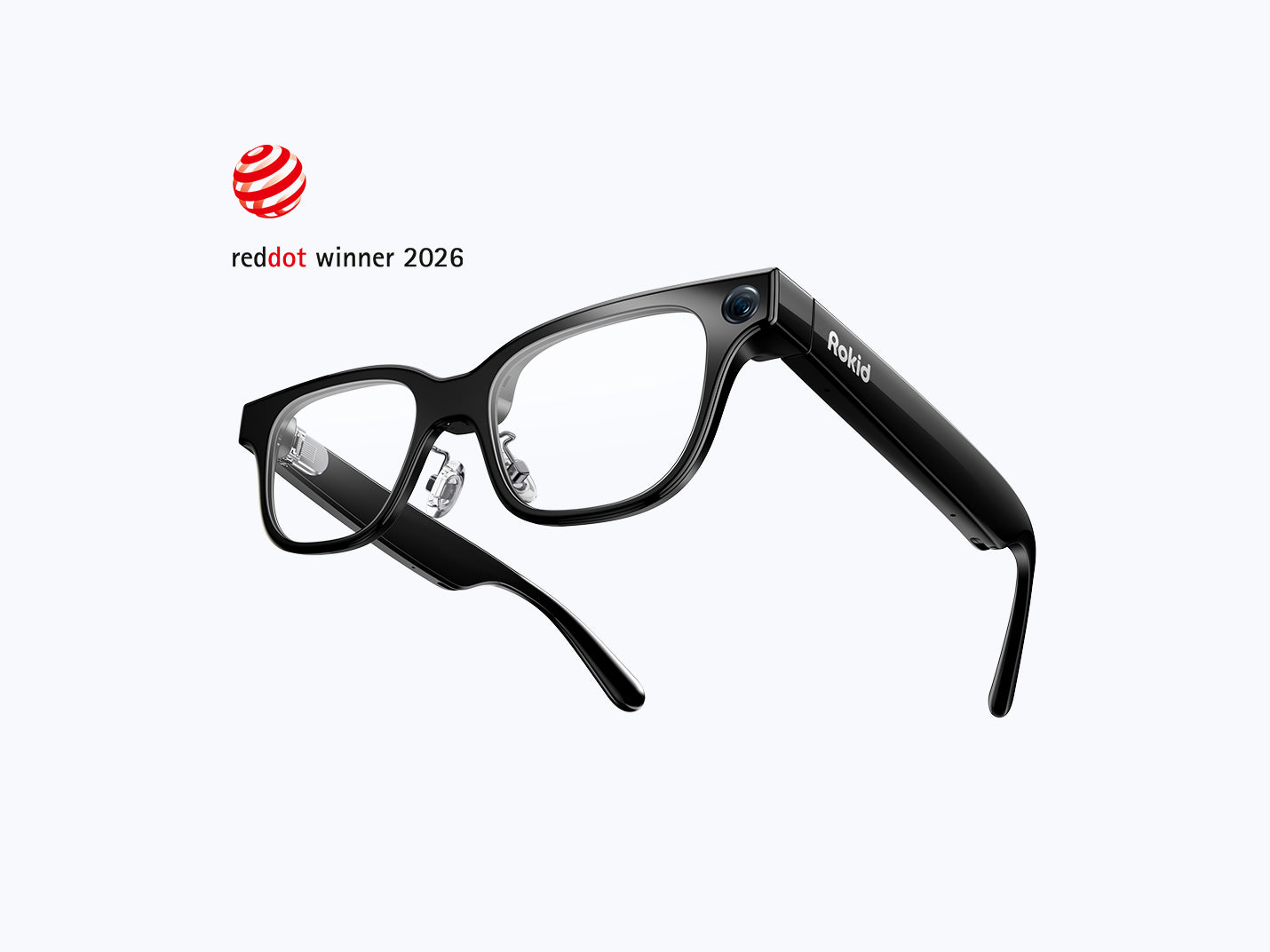
On October 29, 2026, Chinese augmented reality hardware maker Rokid unveiled the Rokid Color, an ambitious pair of lightweight smart glasses built around a full-color micro-LED display. Tipping the scales at a remarkably light 55 grams, the new device marks the company's first hardware release featuring an onboard color optical engine inside an everyday eyewear silhouette. According to specifications shared at launch, the integrated display handles everything from incoming notifications and video playback to a real-time camera viewfinder for still photography.
The core talking point, however, lies in how users will interact with that interface. Rather than relying solely on voice commands or capacitive temple sensors, Rokid is deploying a multimodal control scheme. The Rokid Color supports physical touch controls along the frame, pairs with an external touch-sensitive smart ring, and integrates internal eye-tracking hardware. While Rokid has yet to publish full technical schematics detailing the sensor cluster, Gizmodo reporter James Pero notes that eye tracking on similar smart glasses typically relies on miniature pupil-tracking modules around one millimeter across, allowing users to scroll menus and confirm selections hands-free.
That hybrid approach directly targets the biggest usability bottleneck in modern smart eyewear: input friction. Traditional voice prompts feel awkward and intrusive in quiet offices or crowded trains, while continuously lifting a hand to tap a glasses arm quickly causes arm fatigue and draws unwanted public attention. Pairing a subtle ring gesture with an active eye-tracking sensor lets users look at an icon or notification pill and tap their index finger against their thumb to select it, creating an almost invisible control loop.
How it compares: The Rokid Color clearly takes aim at Meta's display-equipped hardware, specifically competing against concepts like the Meta Ray-Ban Display. While Meta has focused on voice-first artificial intelligence alongside temple taps, Rokid is offering a broader physical and optical toolset. The smart ring concept mirrors the peripheral strategy seen with hardware like the Even Realities Even G2, but pairing that discreet physical input with eye tracking gives Rokid a significantly more dynamic navigation model than monocle heads-up text prompts.
What this means: Eye tracking represents the holy grail of spatial UI, but squeezing infrared illuminators, miniature camera sensors, and real-time gaze processing into a 55-gram frame presents steep engineering trade-offs. Micro-LED engines require substantial driving current to overpower ambient daylight, and running continuous computer vision algorithms to map pupil coordinates can drain tiny temple-mounted batteries in short order. If Rokid managed to preserve viable all-day battery endurance while running both the optical engine and gaze detection, the Rokid Color could set a new benchmark for form-factor efficiency across the entire industry.
What to watch next is real-world latency and gaze accuracy. Rokid will need to prove that its eye-tracking array works reliably across diverse facial shapes, pupil distances, and prescription lens inserts without requiring tedious recalibration every time the glasses slide slightly down the nose. If the tracking proves crisp and effortless, eye-driven navigation will quickly transition from an experimental feature into an expected baseline for premium smart eyewear.
Interactive guide: prices, displays, cameras, battery.
Share this story