Manufacturer News · RayNeo
RayNeo Cuts iO Smart Glasses to $389 and Teases Public SDK
Capitalizing on strong global shipment share, RayNeo is discounting its AI eyewear and gaming displays while preparing a community developer toolkit.
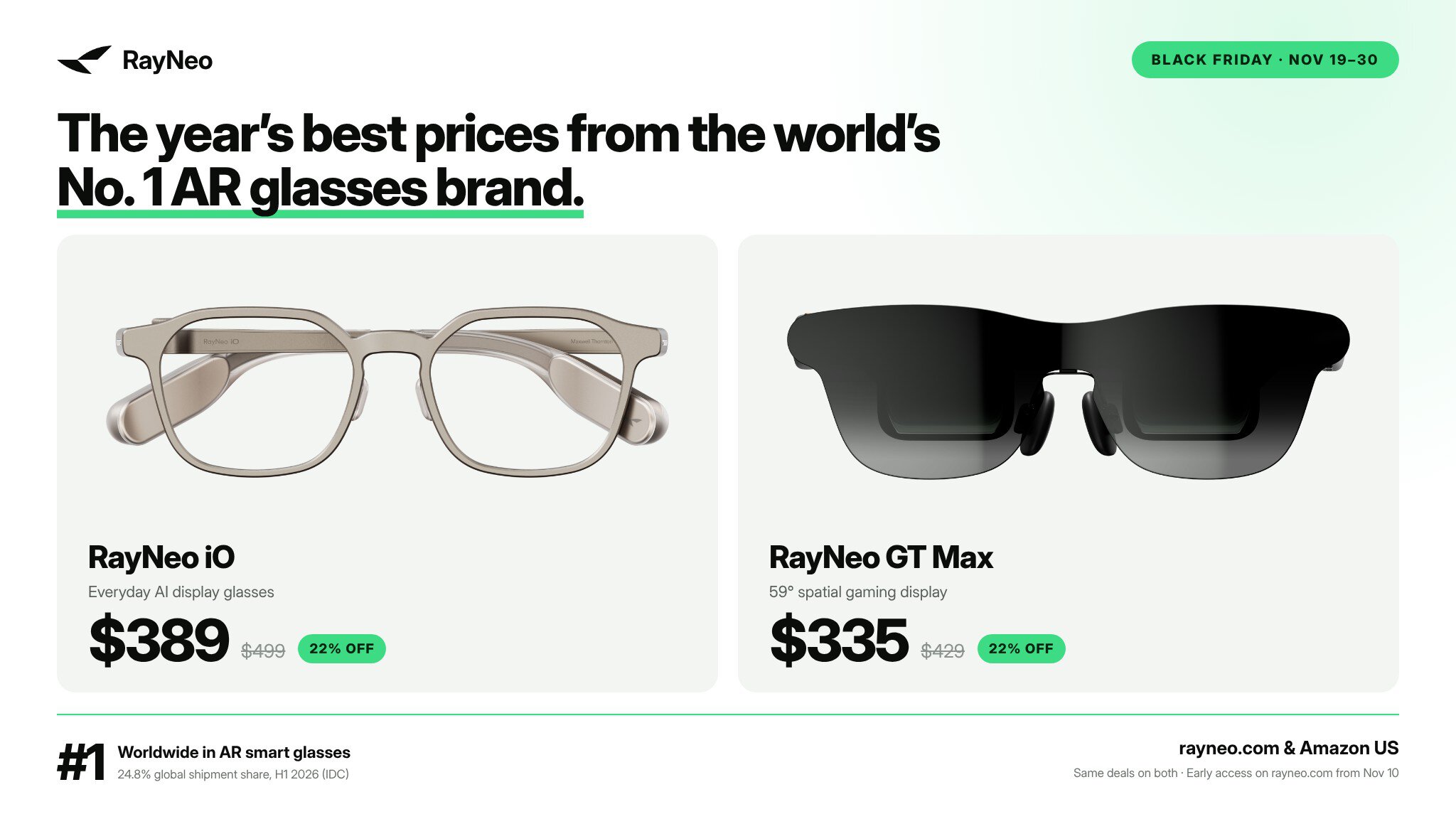
On November 23, 2026, RayNeo outlined its year-end holiday campaign, rolling out aggressive promotional pricing across its smart eyewear lineup while highlighting its climb to the top of the global augmented reality hardware market. As reported by androidauthority.com, market tracker IDC credited RayNeo with a 24.8 percent share of global AR smart glasses shipments for the first half of the year, while Counterpoint Research pegged the figure at 23.9 percent. The promotional discounts on hardware like the RayNeo iO and RayNeo GT Max signal an effort to consolidate that volume lead ahead of 2027.
The RayNeo iO sits squarely in the emergent category of discreet, all-day AI eyewear. Built to resemble standard designer optical frames, the device houses a micro-optical heads-up display embedded directly within the lens structure, keeping digital content hidden from onlookers. Unlike heavier XR visors, the hardware emphasizes ambient notifications, heads-up turn-by-turn navigation with street names and transit alerts, and hands-free artificial intelligence without demanding constant interaction with a smartphone.
Under the hood, the iO combines the company's proprietary RayNeo V1 software architecture with Google's Gemini 3.1 Flash Lite model for immediate voice responses and lightweight visual assistance. For the holiday window running through November 30, RayNeo trimmed the base iO price to $389, down 22 percent, while pricing the bundle that includes a dedicated portable charging case at $428. Hardware buyers who set up their devices before December 18 also receive a six-month AI Pro VIP subscription, granting access to high-tier models including ChatGPT 5.5, Gemini 3.1 Pro, DeepSeek V4 Pro, Qwen 3.7 Max, and Kimi K2.7.
To lower the friction for everyday wearers, RayNeo is also targeting prescription lens users. Between November 27 and November 30, the brand is waiving the typical $159 fee for standard custom prescription lenses on compatible iO frames, matching the entry price of plain optical units. In addition, RayNeo confirmed plans to release a public software development kit in December 2026, intended to let third-party developers and hobbyists build standalone community apps for the eyewear without requiring extensive programming expertise.
For spatial computing and gaming enthusiasts, the company also discounted its RayNeo GT Max to $335. Unlike the discreet notification-oriented iO, the GT Max is built as a tethered wearable display delivering an expansive 59-degree field of view designed to emulate a massive personal monitor for mobile gaming, console connections, and media playback.
Our take: RayNeo's bifurcated strategy illustrates where the consumer smart eyewear market actually stands at the close of 2026. Instead of forcing one compromised device to handle both high-FOV immersion and all-day public wearability, the company is offering distinct paths: the iO for stealth AI assistance and the GT Max for private media consumption. Subsidizing custom prescription glass and lowering sub-$400 entry barriers will do far more to put optical waveguides on ordinary faces than chasing unproven mixed-reality gimmicks. If the upcoming December SDK launch attracts meaningful developer momentum, RayNeo could turn its shipment volume into a durable software ecosystem.
Interactive guide: prices, displays, cameras, battery.
Share this story