Apps & Use Cases · Meta
Ray-Ban Meta Glasses Find a Purposeful Niche in Vision Rehabilitation
A Florida nonprofit is training visually impaired adults to use Ray-Ban Meta smart glasses for daily visual tasks, showing how mainstream AI wearables can double as assistive tech.
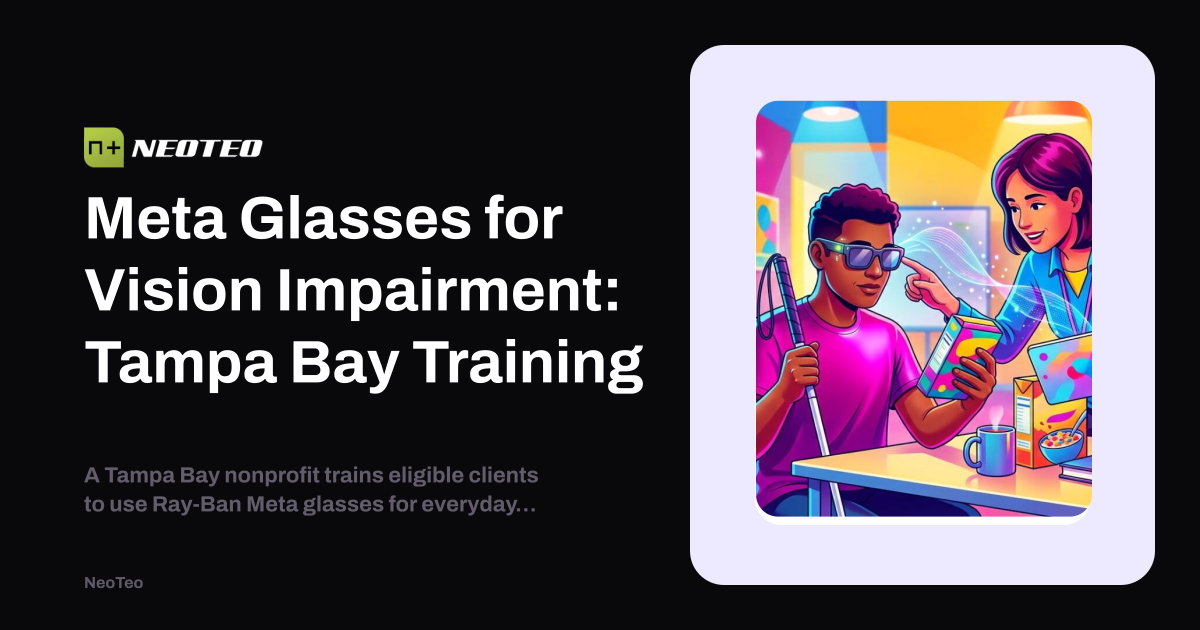
On November 18, 2026, reports highlighted a growing real-world accessibility initiative in Florida, where second-generation Ray-Ban Meta glasses are being deployed as daily assistive devices. According to neoteo.com, citing an earlier report by Fox 13, The Lighthouse for the Visually Impaired and Blind in Tampa Bay has developed a structured training curriculum to help clients leverage the hardware for tasks like reading ingredient packaging, cooking instructions, and recognizing everyday surroundings.
The initiative is not an official rollout backed by Meta, but rather an independent program run by the local nonprofit across Florida's Pasco, Hernando, and Citrus counties. As reported by neoteo.com, the training began roughly a year prior and has already graduated several dozen participants. To qualify for the smart glasses curriculum, clients must first complete the organization's standard vision rehabilitation coursework before receiving guided instruction on voice prompts, companion app navigation, and multimodal AI features.
The primary draw of the Ray-Ban Meta frames in this context comes down to hands-free convenience. neoteo.com notes that staff and clients use features like Meta AI's Detailed Responses to obtain richer auditory descriptions of rooms and objects, alongside continuous Live AI sessions to locate misplaced items. The glasses also integrate with Be My Eyes, allowing wearers to initiate hands-free video calls with sighted volunteers who can provide real-time guidance directly through the frame's open-ear speakers.
Client testimony captured by Fox 13 underscores the emotional impact of the setup: participant Victor Bennett explained that using the glasses significantly cut down his reliance on others for basic chores. At the same time, the training emphasizes critical boundaries. Meta explicitly warns users during onboarding that AI descriptions can be inaccurate, hallucinate details, or fail in tricky lighting. Most importantly, the hardware is never to be treated as a mobility aid or a substitute for a white cane or guide dog.
What this means: For years, dedicated assistive tech hardware has been defined by eye-watering markups, clunky industrial designs, and slow update cycles. A specialized optical character reader or head-mounted accessibility sensor can easily cost several thousand dollars. By contrast, a pair of Ray-Ban Meta frames retails starting around $299, delivering high-grade microphones, clear spatial speakers, and capable computer vision in a form factor that looks like standard designer eyewear.
Our take: Mainstream consumer smart glasses are quietly solving the adoption hurdle that niche accessibility gadgets never could: social comfort. When visually impaired users wear Ray-Ban Meta frames, they do not stand out in a crowd or signal a disability unless they choose to. While developers still need to refine latency and eliminate AI hallucinations before these devices can assist with high-stakes navigation, grassroots training programs like Lighthouse prove that ambient multimodal AI is already making a tangible, independent living impact right now.
Interactive guide: prices, displays, cameras, battery.
Share this story