Manufacturer News · Meta
Meta's Latest AI Glasses Surface in FCC Filings, Feature Mysterious Debug Port
Fresh regulatory filings reveal new smart glasses submitted directly by Meta alongside a dedicated USB debug tool.
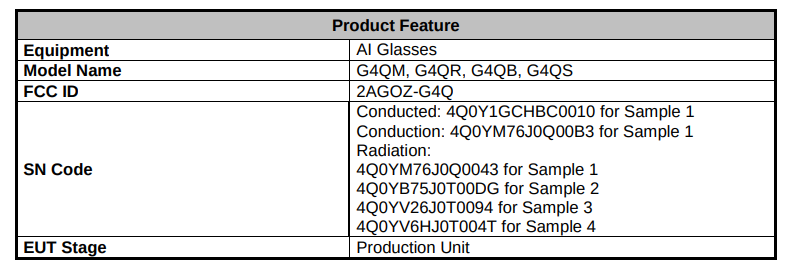
On May 30, 2026, regulatory documentation surfaced indicating that Meta is preparing to launch a new line of smart glasses, as revealed in newly published Federal Communications Commission filings. First reported by Janko Roettgers of Lowpass, the regulatory exhibits list four distinct model designations: G4QM, G4QR, Q4QS, and G4Q. While the public documents remain heavily redacted to protect proprietary schematics, the paperwork signals that fresh wearable hardware is entering the final stages of regulatory review.
The most telling detail in the documentation is the identity of the applicant. In past collaborations, Meta's manufacturing partner EssilorLuxottica handled the regulatory legwork for jointly developed eyewear, including the popular Ray-Ban Meta lineup. As Roettgers points out at Lowpass, EssilorLuxottica submitted the paperwork for previous consumer models, with direct Meta filings previously reserved for display-enabled experiments such as the Ray-Ban Display models. That Meta filed these documents directly suggests this release may deviate from the standard retail formula, potentially marking either a display-equipped product, a new industrial partner, or a standalone Meta-branded device.
The filings also include a separate application for a dedicated hardware accessory labeled as a debug tool. According to the Lowpass report, this adapter appears designed to establish a direct physical link between the smart glasses and a computer via a standard USB port. In consumer smart glasses, physical ports are virtually nonexistent on shipping retail frames due to weatherproofing constraints and aesthetic demands. A dedicated debug interface points to specialized equipment used for firmware flashing, high-throughput telemetry, or developer diagnostic testing.
Meta currently dominates the displayless smart eyewear segment with its Ray-Ban frames, which rely entirely on wireless synchronization via Bluetooth and Wi-Fi to move data to the companion smartphone app. Integrating a hardware debug bridge into regulatory submissions suggests that whatever hardware Meta is validating could contain more intricate compute architecture or sensor payloads than simple audio and camera components. Developing frames with onboard spatial sensing or optical engines requires far more robust low-level diagnostics during field testing.
Our take: Direct filings from Meta signal that the company wants tighter operational control over its next phase of wearable hardware. While EssilorLuxottica brings world-class frame styling and optical retail networks, devices that incorporate heads-up micro-displays, neural input integration, or heavier thermal envelopes demand deep silicon-level oversight. A proprietary debug adapter strongly implies that Meta is building out developer-facing hardware or preparing internal prototypes for extensive software testing ahead of a broader platform transition.
FCC disclosures typically precede a commercial rollout by three to six months, as regulatory authorization is among the final milestones before mass production and retail distribution. With Meta typically using its autumn Connect conference to unveil key spatial computing hardware, these documents suggest the company is keeping its hardware pipeline strictly on schedule. The coming months will reveal whether these four model numbers represent a luxury display frame, an enterprise developer kit, or the next consumer generation of smart eyewear.
Interactive guide: prices, displays, cameras, battery.
Share this story