News · INMO
INMO GO3: Setting a New Standard for Everyday AI Smart Glasses
INMO's latest offering, the GO3, combines an ultralight design, swappable batteries, and advanced AI features, aiming to seamlessly integrate smart glasses into daily life.
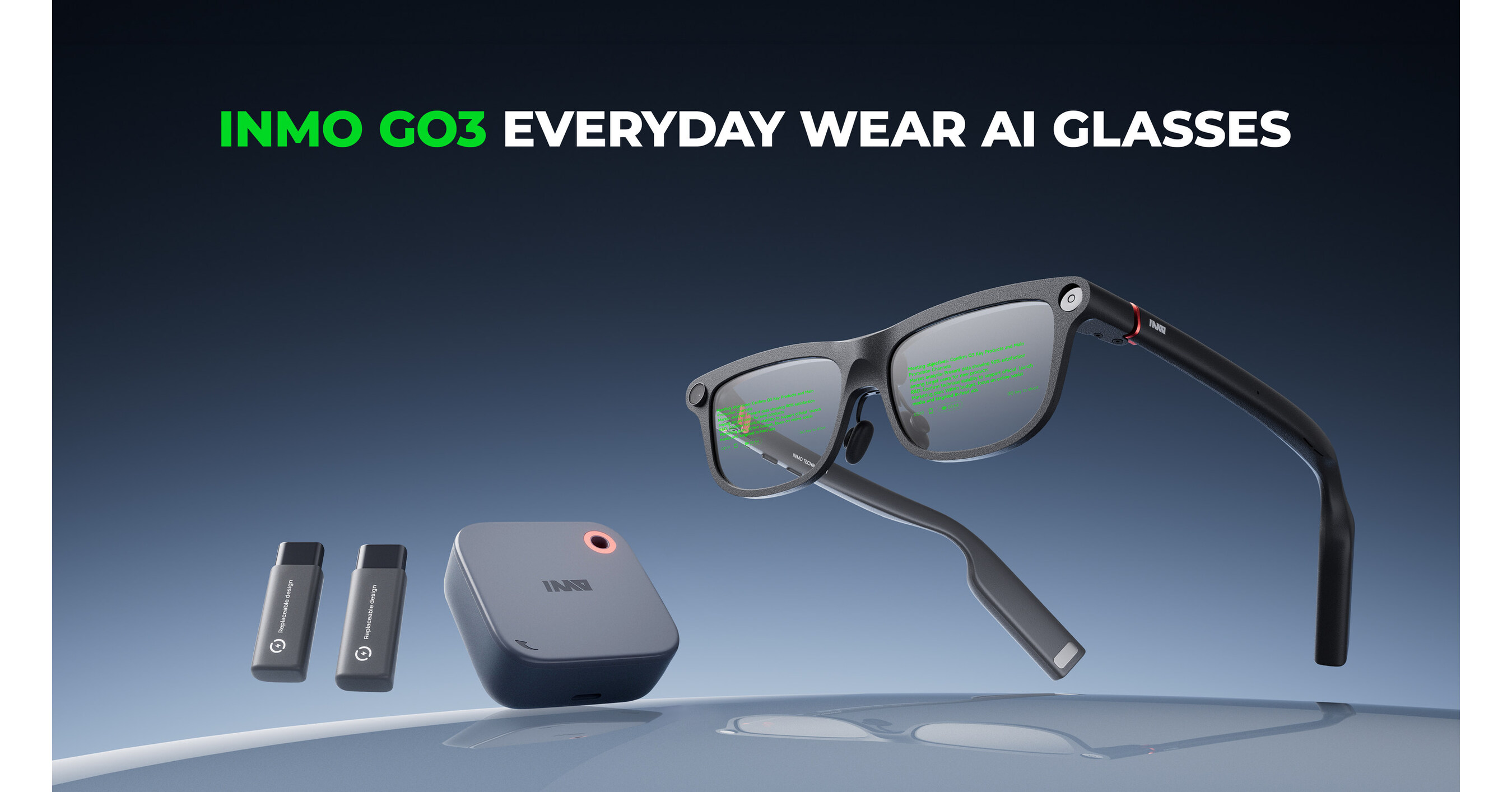
CHENGDU, China - On April 2, 2026, INMO announced the global launch of its next-generation everyday AI smart glasses, the INMO GO3. This new device is slated for an exclusive debut via a limited-time crowdfunding campaign on Kickstarter, commencing in April.
According to Inmo of prnewswire.com, the GO3 previously made its international debut at CES 2026, where it garnered 'significant attention' and earned the Digital Trends CES 2026 Publisher Award. Inmo reports that with the commercial launch approaching, INMO aims to transition AI smart glasses 'beyond concept devices and into real world daily use'.
Inmo of prnewswire.com details the GO3's design, noting its lightweight structure 'comparable to traditional eyewear'. The piece highlights a key innovation: a 5-second magnetic swappable battery system. This system is supported by a charging case that includes two additional replaceable batteries, designed to ensure 'uninterrupted use throughout the day'. Inmo also points out the 'ultra-slim 8 mm eyeglass temple' which integrates both the motherboard and battery, creating a 'streamlined structure' that balances portability with performance.
For visual output, Inmo describes dual Micro OLED displays utilizing diffractive waveguide technology, delivering a 640×480 resolution that ensures 'crisp, stable visuals with no ghosting'. A physical privacy cover is also integrated over the camera, allowing users to 'instantly' cover the lens for enhanced security in public environments.
Beyond hardware, Inmo of prnewswire.com elaborates on the GO3's integrated AI capabilities, framing the device as a 'versatile personal assistant'. Features include real-time bilingual conversation translation across up to 98 languages when paired with the INMO Speaker. Inmo adds that additional AI functionalities encompass automatic meeting transcription, an integrated AI teleprompter, and voice-activated web search. HERE Maps provides hands-free navigation with directions displayed directly in the user's field of view. The system also supports AI-assisted writing, summarization, task management, and adaptive AI recommendations that aim to prioritize relevant information based on user context.
Our take: The INMO GO3 appears to be taking a practical approach to smart glasses, emphasizing user-centric design such as swappable batteries and a privacy cover. This focus on everyday usability and tangible AI features, rather than just raw processing power or complex AR overlays, positions the GO3 as a strong contender in the evolving wearable tech market. The combination of hardware ingenuity and a broad suite of AI applications could indeed help push smart glasses into the mainstream by addressing common user concerns like battery life, privacy, and real-world utility. We've been tracking the slow but steady consumer adoption of smart glasses, and products like the GO3 could mark a turning point.
Interactive guide — prices, displays, cameras, battery.
Share this story