Analysis · -
Every Other Camera Spies on You Silently. Meta's LED Doesn't.
Street cameras, parking lots, Teslas, store sensors — they all record you without warning. Meta's capture LED is the only visible signal that says 'you are being filmed.' That transparency is why these glasses are the safest camera in public.
It is time to invert the privacy debate surrounding smart glasses. For too long, the narrative has demonized devices like Meta Ray-Ban and Oakley Meta as 'pervert glasses,' fixating on their camera capabilities. This perspective completely misses the broader, more insidious truth: Meta's proactive embrace of a non-defeatable capture LED makes their eyewear the single most privacy-respectful recording device operating in public spaces today.
The 'pervert glasses' moniker, fueled by sensational media coverage and a general distrust of Big Tech, ignores the constant, pervasive visual capture happening all around us. While headlines scream about Meta's 'privacy crisis' and 'kill switch' patents, a fundamental reality remains unaddressed. The very public clamoring for privacy is often aimed at the one device that actually signals its intent to record.
Consider the true landscape of public surveillance. Municipal CCTV cameras track our movements from every intersection. Retail establishments record every aisle and checkout. Doorbell cameras like Ring and Arlo capture every pedestrian, dog walker, and delivery driver. These systems operate 24/7, silently, without a single blink or sound to alert those being recorded.
The rise of automotive surveillance has amplified this silent recording exponentially. Nearly every new car on the road is a mobile surveillance unit. Tesla's Sentry Mode famously records its surroundings when parked, but beyond that, front and rear dashcams are ubiquitous, and advanced driver-assistance systems (ADAS) employ multiple camera arrays that capture continuous, high-definition footage of public streets and pedestrians.
None of these pervasive, always-on recording systems offer any visible indicator to those being filmed. There is no flashing light on a municipal pole, no audible click from a store security camera, and certainly no signal from a passing car that its ADAS system is capturing your image. This is surveillance on an unprecedented scale, utterly devoid of consent or even notice.
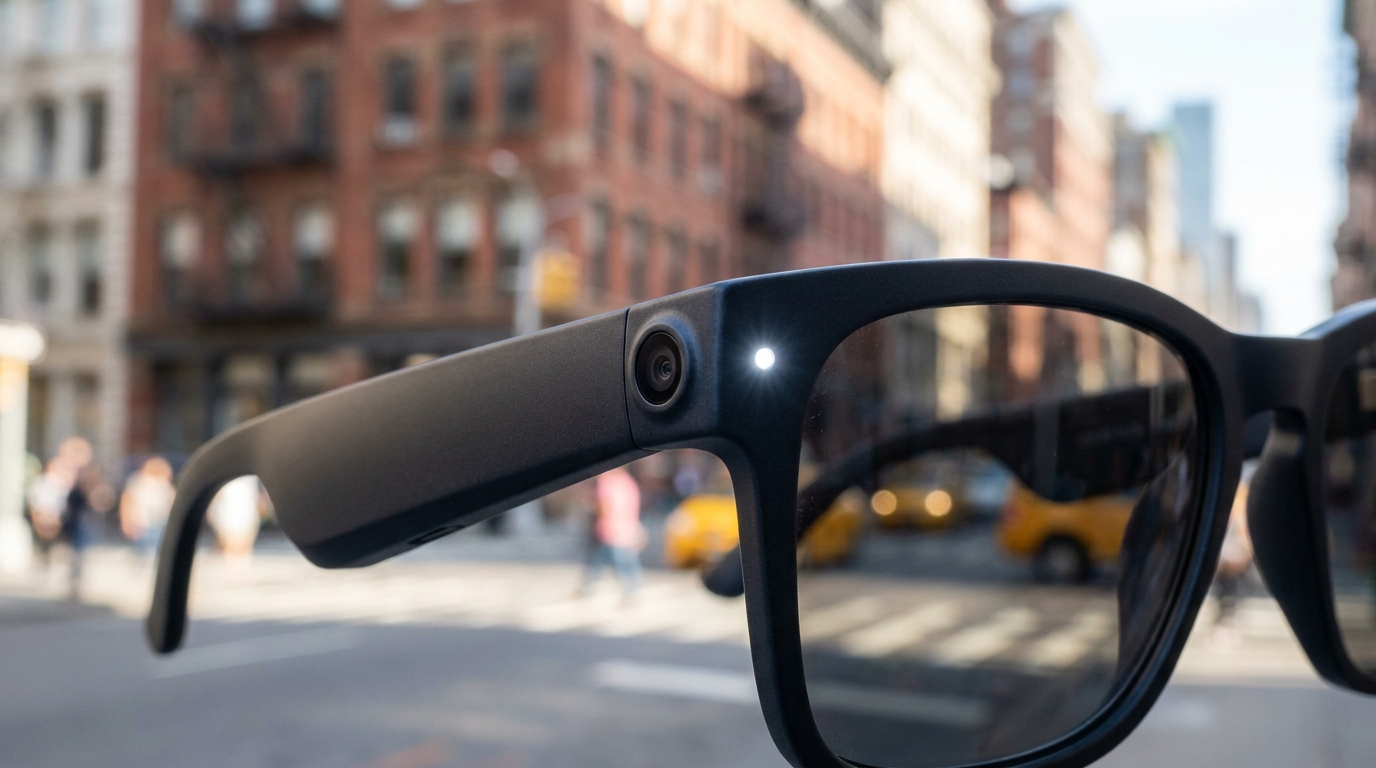
In stark contrast, Meta's Ray-Ban and Oakley Meta smart glasses stand alone. They are explicitly designed to include a visible, active capture LED that illuminates whenever the device is recording video or taking a photo. This is not a mere suggestion of privacy, it is a direct, undeniable signal to anyone within line of sight.
Meta has gone further, hardening this mechanism into a mandatory recording condition. Recent mandatory firmware updates, rolled out in mid-2026, transformed the capture LED's role completely. As confirmed by Meta's VP of AR Alex Himel, these updates now automatically halt any recording if the LED is obscured mid-capture. If bystanders cannot see the light, the recording effectively ceases, making the LED a 'direct hardware permission.'
While Meta also explored a 'kill switch' patent as a reactive measure to privacy concerns, the continuous monitoring and enforcement of the capture LED is a far more robust and publicly-facing solution. It shifts the burden of awareness to the recorder, ensuring that the act of recording is never truly covert, unlike every other camera system mentioned.
This is not without historical precedent. Cast your mind back to the early 2000s, when camera phones first became widespread. A similar moral panic erupted, particularly in Japan, over 'creepshots.' The societal fix, rapidly adopted by Japanese carriers and eventually mandated by regulation, was a non-defeatable shutter sound every time a photo was taken.
That audible shutter sound became the accepted social contract for camera phone use. It was a clear, unambiguous signal that recording was occurring. The visible, non-defeatable capture LED on Meta's smart glasses is exactly the same fix, updated for a new generation of wearable technology. It is an active, undeniable consent signal in a visual medium.
The ongoing 'consent theater' surrounding smart glasses is a profound distraction from the real privacy challenges we face. To focus outrage on the one device that signals its recording intent, while ignoring the silent, ubiquitous cameras that actually erode public privacy, is a critical misdirection. It is arguably fueled by a blend of media sensationalism, technological apprehension, and perhaps even a touch of envy.
This inverted public discourse risks undermining genuinely proactive privacy mechanisms. Instead of condemning the 'pervert glasses' narrative, we should be demanding that every camera operating in public spaces, from municipal surveillance to automotive ADAS, adopts a similar, non-defeatable visual or audible indicator. Only then can true informed consent be a public reality.
Meta, through its robust enforcement of the capture LED, has ironically emerged as the unlikely leader in privacy-respectful public recording. The true privacy crisis is not the smart glasses that announce themselves, but the countless silent lenses that watch our every move with absolute impunity and zero notice. It is time we directed our concerns where they truly belong.
The framework for privacy, as enshrined in regulations like GDPR, emphasizes informed consent and transparency. A mandatory, non-defeatable visual indicator aligns perfectly with this principle. It is time to recognize the capture LED for what it is: not a flaw to be circumvented, but a feature to be celebrated and, critically, emulated by all who capture public space.
It is also worth noting that Meta glasses are banned in courtrooms simply because all cameras are banned there. The same applies to cinemas, theaters, and other sensitive venues: these are places where photography and recording devices were already prohibited long before smart glasses arrived. This is not a new or Meta-specific restriction; it is an existing rule that should not be conflated with a broader social issue.
Interactive guide — prices, displays, cameras, battery.
Share this story