
News · Samsung
Smart Glasses Expose Severe Security Blind Spots at Semiconductor Fabs
South Korean chipmakers and defense contractors scramble to plug security holes as discreet AI glasses slip past legacy turnstile checkpoints.
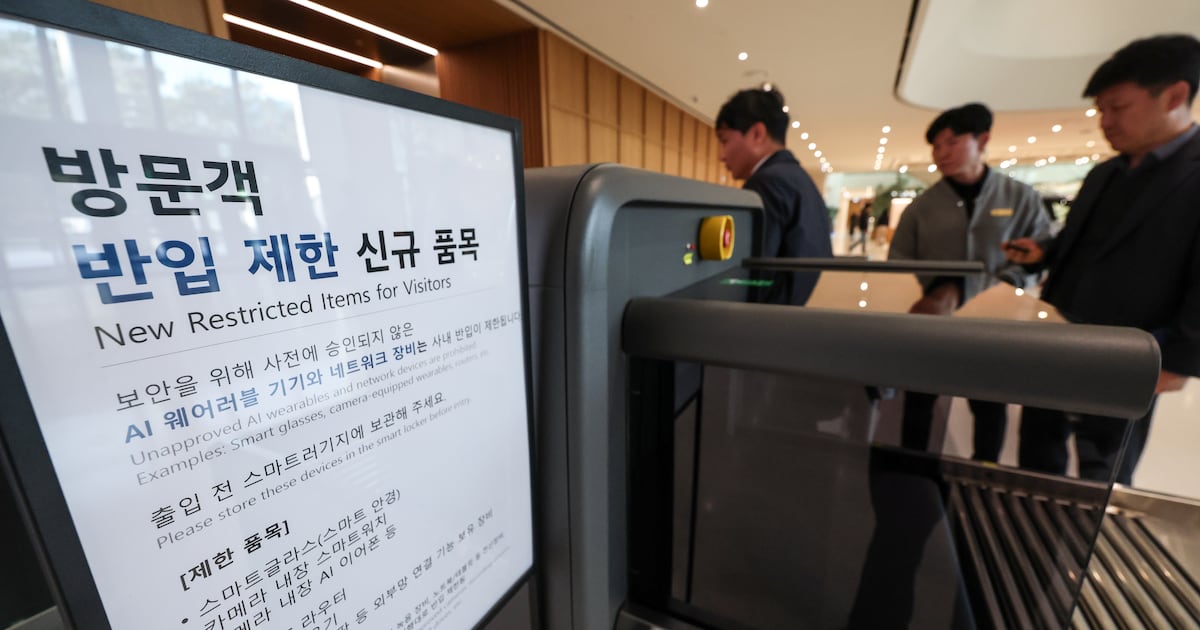
On November 16, 2026, corporate security protocols at South Korea's premier industrial and technology hubs faced an urgent reckoning over covert wearable computing. According to reporting by chosun.com journalist Soonchan Park, facilities spanning national defense contractors to chipmakers like Samsung Electronics and SK Hynix are struggling to detect camera-equipped AI glasses brought into high-security cleanrooms and executive meeting rooms. The vulnerability was underscored when corporate campuses began installing physical warning signs restricting smart eyewear, highlighted by Hyundai Motor and Kia explicitly banning AI glasses, camera-enabled smartwatches, and AI earphones at their Yangjae headquarters in Seoul.
The issue moved from a hypothetical risk to an immediate operational headache following a high-profile cheating scandal during South Korea's national tax accountant exam, where a top scorer used miniature optics and AI support to illicitly relay test materials. As chosun.com reports, that exposure triggered emergency reviews across the business sector regarding industrial espionage and wearable hardware. The anxiety extends beyond internal staff to prospective hires, with corporate security teams voicing concern that job applicants wearing smart eyewear could easily record proprietary interview technical prompts and confidential workplace layouts.
The technical vulnerability stems from an asymmetrical security perimeter. Top-tier semiconductor fabrication plants enforce some of the strictest data-protection rules in the technology industry. Workers must install mobile device management software that disables smartphone camera sensors at entry turnstiles, unauthorized wireless tethering is blocked, and outgoing staff navigate layered exit checks to stop physical media from leaving the premises. Yet, as a semiconductor industry source told chosun.com, security gates only flag discrete storage media like USB drives, leaving wearable frames virtually undetected. Unless an employee voluntarily declares their frames, staff can walk past checkpoints wearing everyday-looking glasses, record chip manufacturing workflows or blueprints to internal storage, and walk out undetected.
Defense contractors face an identical gap. While external visitors undergo metal detection and X-ray screening, credentialed employees typically pass through gates by scanning an ID badge alone. Representatives from multiple defense contractors acknowledged to chosun.com that they possess no reliable mechanism to screen out glasses that appear visually identical to standard prescription frames.
What this means: The consumer smart eyewear industry has spent years striving to make AI glasses indistinguishable from ordinary acetate and titanium spectacles. Success on that design front now presents an existential challenge for enterprise intellectual property protection. Unlike smartphones, which are handheld, obvious, and easily locked down via corporate software profiles, smart eyewear functions as a passive, head-mounted sensor array that doubles as necessary vision correction. Security officers cannot simply confiscate prescription frames at the door without disrupting basic work, nor can standard metal detectors reliably differentiate between a micro-battery and a conventional wire core inside an acetate temple.
Looking ahead, industrial security will be forced to evolve through specialized hardware scanning rather than visual policing. Expect cleanrooms and defense campuses to deploy active millimeter-wave sensors, optical lens-glint detectors, and localized radio-frequency sweeps at employee turnstiles to flag hidden image sensors and local storage boards. Until those detection systems mature, the friction between consumer AI eyewear adoption and industrial secret protection will only escalate, driving corporations toward blunt, zero-tolerance policies at the factory gate.
Interactive guide: prices, displays, cameras, battery.
Share this story





