Manufacturer News · Meta
Meta Targets Best Buy For Unified AI Glasses, VR Demos
The tech giant plans new pop-up installations to showcase its Ray-Ban AI glasses alongside Quest VR headsets. This strategy aims to streamline product exposure for consumers.
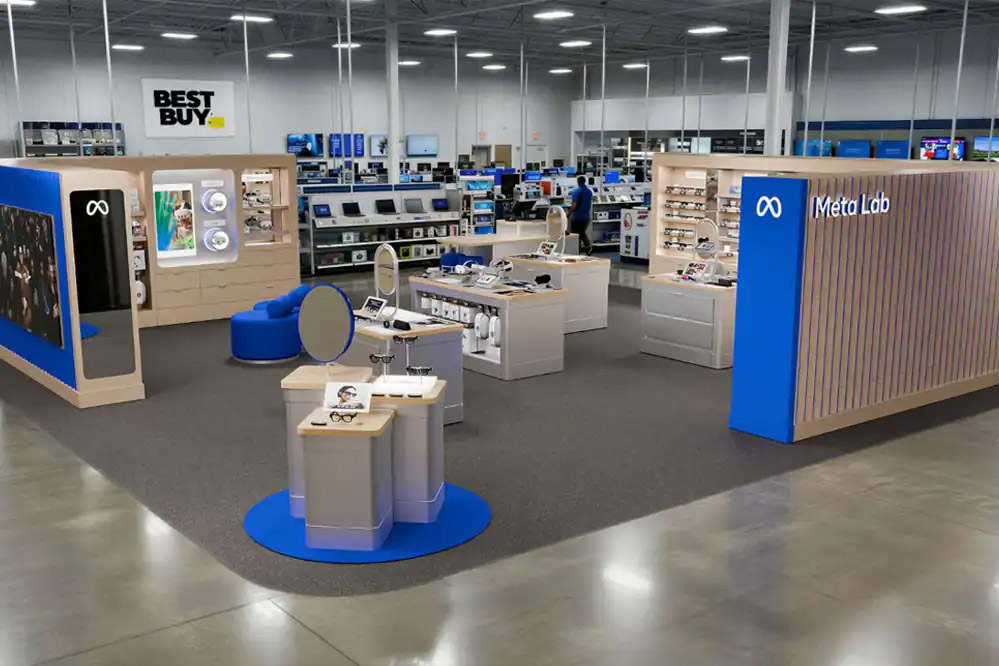
On June 8, 2026, Meta revealed plans to establish new pop-up retail experiences within Best Buy stores, designed to integrate demonstrations of its AI glasses and virtual reality headsets. Road to VR reported on this initiative, noting that the installations will specifically highlight Ray-Ban Meta smart glasses alongside Meta's Quest VR devices.
What this means: This strategic alignment signals Meta's intent to simplify its expanding hardware portfolio for the general public. By presenting its smart eyewear and immersive headsets in a cohesive retail environment, Meta can more effectively articulate its vision for spatial computing and an interconnected device ecosystem. This unified demo approach has the potential to educate consumers on the distinct yet complementary roles of each product, fostering broader understanding and potentially driving increased adoption across both key segments.
## Expanding the smart eyewear lineup
Meta's push into physical retail coincides with the diversification of its wearable lineup. Consumers shopping at Best Buy are encountering a growing spread of hardware options. In the sports performance category, the Oakley Meta HSTN frames, released on August 26, 2025, sell for $399. Those glasses weigh 48 grams, operate without a display, and feature an 8-hour battery alongside a 12 MP camera capable of recording 1080p video. Update: Since this article was published, Meta launched the Ray-Ban Meta (Gen 3) glasses on September 23, 2026, starting at $449. The Gen 3 frames offer a slimmer profile, a customizable action button, a 9-hour battery life, and a 12 MP camera capturing 3K Ultra HD video. Audio features on Gen 3 include open-ear stereo speakers with Dolby Atmos playback and a 6-microphone array providing over 90 percent background-noise reduction, with Dolby Atmos 360-degree capture due later in 2026.
Update: Since this article was published, Meta released the Ray-Ban Meta Audio frames, which began shipping on October 13, 2026, with a starting price of $349. They weigh 43 grams and omit both displays and cameras. They deliver a 12-hour battery life, four case charges, open-ear stereo sound, and a 6-microphone array connected to Meta AI and the Muse agent. Update: Since this article was published, Meta announced the cat-eye style Meta Capri at Connect 2026 for a September 2026 release, featuring a camera and open-ear audio. Update: Since this article was published, Meta also announced the Meta Fury for September 2026, a limited-edition clear frame with mirrored lenses featuring on-device AI and a camera, designated for a limited launch at Connect and Meta Labs.
## Bridging smart glasses and spatial displays
The unified Best Buy pop-ups will also help Meta show how smart eyewear connects to its broader display roadmap. As we reported on Meta Quest delivering immersive NBA highlights to VR headsets, Meta has used Quest 3 and Quest 3S hardware to show 180-degree, 8K sports viewing with Dolby Atmos. That immersive focus extends toward future form factors. Update: Since this article was published, Meta announced the Meta VR Glasses, planned for a March 2027 release at $1,299.99. Weighing 100 grams, the tethered display glasses require a fiber-optic cable connection to an external puck powered by the Snapdragon Reality Elite chip. They feature Dual micro-OLED Infinite Displays with 2412 x 2288 resolution per eye, a 120 Hz refresh rate, a 3-hour battery, and support for IMAX Enhanced, Dolby Vision, and Dolby Atmos.
## Retail strategy amid privacy and competition
Demonstrating hardware directly in Best Buy stores gives Meta a physical venue to address consumer hesitation around smart eyewear. As we reported on US Senators demanding answers from Meta over AI glasses privacy risks, lawmakers Ron Wyden and Edward Markey pressed the company over bystander safety and footage access. Privacy scrutiny has also grown abroad. As we reported on EssilorLuxottica's Ray-Ban Meta dominance facing mounting regulatory scrutiny in Europe and political sting fears in India, public comfort with embedded cameras remains a hurdle. Physical demos allow staff to explain privacy features directly and highlight camera-free choices like the Ray-Ban Meta Audio glasses.
Competitive pressure in retail is also intensifying. As we reported on RayNeo, XREAL, and Rokid owning the display war, Asian display specialists have focused on private spatial monitors rather than camera frames. Furthermore, as we reported on the Android XR reckoning, Google is preparing an open ecosystem to challenge Meta's market position. By pairing lightweight Ray-Ban AI frames and Quest headsets under one roof, Meta aims to show that its audio, camera, and virtual reality devices form a cohesive ecosystem.
Interactive guide: prices, displays, cameras, battery.
Share this story