Analysis · —
The Glanceable Revolution: Why HUD-Only Glasses Are Quietly Resurfacing
While Meta champion's 'display-less' AI, a different, more practical form of smart eyewear is making a silent return. Minimalist heads-up displays offer utility without the AR spectacle, carving out a crucial middle ground.

The smart glasses discourse often defaults to extremes: either the subtle, AI-first approach championed by Meta, or the grand, yet niche, augmented reality visions from players like Apple. Meta's focus on "display-less" utility, as seen in Ray-Ban Meta and the new Meta Glasses, has rightly earned accolades for its mass-market appeal and discreet integration. But in our collective enthusiasm for devices without overt screens, we might be overlooking a more pragmatic, equally powerful evolution: the quiet resurgence of HUD-only smart glasses.
Meta's strategy is undeniably effective. Their partnership with EssilorLuxottica, the parent company of Ray-Ban and Oakley, has cemented a foundation of genuine eyewear pedigree, making their $299 Meta Glasses a fashion-forward AI accessible to the masses. Articles on our own Smart Glasses Daily have lauded Meta's "discreet utility" and "ambient AI" as the true path to mass adoption, positioning them as a "Trojan horse" against Apple's more elaborate AR headset ambitions.
This "display-less" philosophy prioritizes audio, camera, and on-device AI processing via Muse Spark, offering intelligent assistance without visual imposition. It sidesteps the historical failures of maximalist AR, which often alienated users with complex, power-hungry displays. Yet, in celebrating the absence of a display, Meta leaves a functional gap: the need for immediate, glanceable information that audio alone cannot always satisfy.
The industry's fixation on beaming pixels directly into our eyes, epitomized by the failures of products like Snap's astronomically priced $2,195 SPECS, has consistently missed the mark for everyday users. This maximalist approach created bulky, socially awkward devices that struggled with battery life and general acceptance. The ambition of AR headsets, while technologically impressive, has proven too much, too soon, for the average consumer's face.
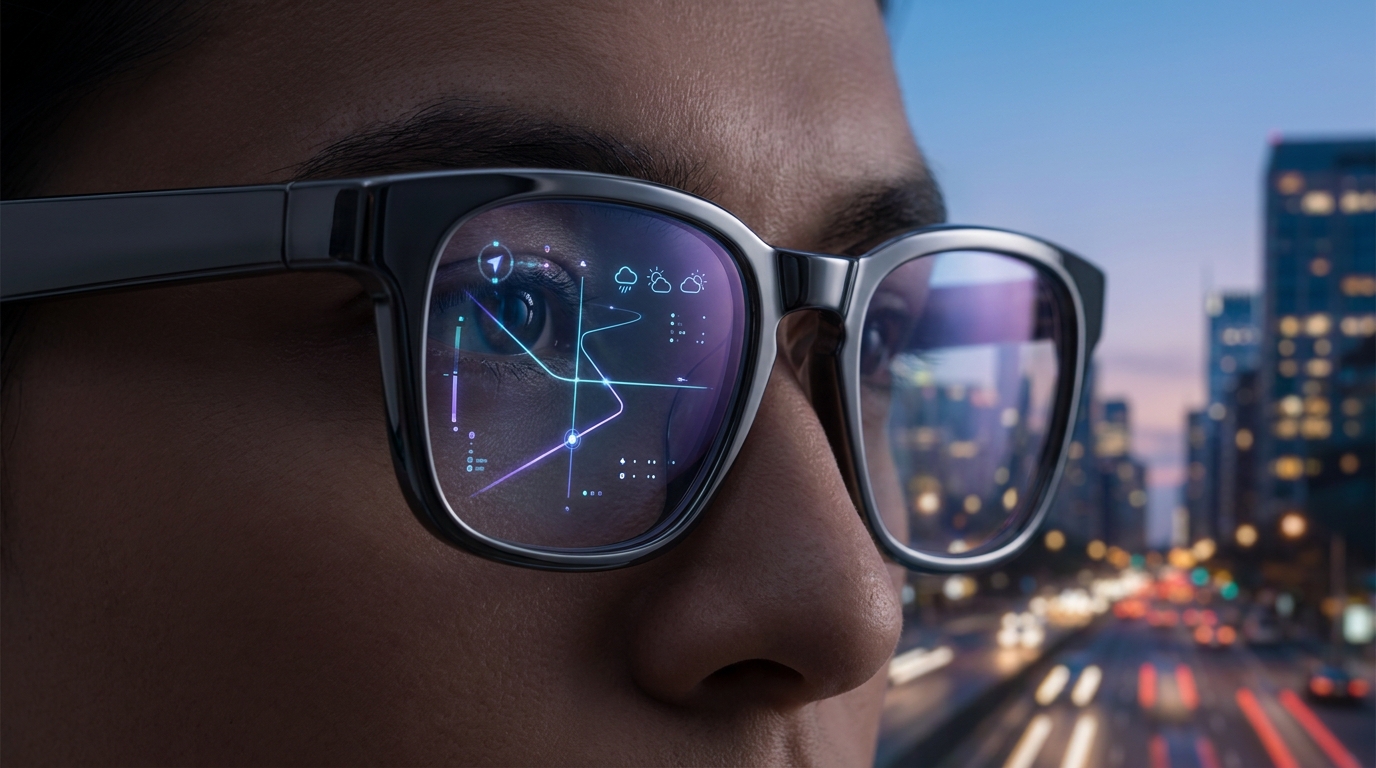
This is precisely where HUD-only glasses find their footing. They are not trying to overlay entire digital worlds onto our physical reality. Instead, they offer minimal, contextual information: a quick navigation arrow, an urgent notification, a subtle data point, all within the user's peripheral vision. This isn't a see-through computer, it's a glanceable assistant, providing utility that is both immediate and unobtrusive.
Furthermore, HUD-only devices, particularly those that omit forward-facing cameras, bypass some of the most pressing privacy concerns that have plagued camera-first smart glasses. Meta, for example, has faced increasing public scrutiny, leading to aggressive measures like mandatory camera disables if users tamper with the recording indicator. The weaponization of smart tech, as seen in a recent €1.5 million crypto fraud case where smart glasses were used for deception, underscores the need for less invasive form factors.
While Meta and other tech giants like ByteDance and Alibaba aggressively carve out proprietary ecosystems, complete with firmware lock-ins, sophisticated AI like Muse Spark, and premium subscriptions, HUD-only devices can offer a different narrative. Many are being developed with an eye towards openness, providing more user control and less ecosystem dependence. This contrasts sharply with the "Ambient Iron Curtain" being drawn by big tech.
Brilliant Labs' Frame stands as a prominent example of this pragmatic shift. It embraces an open-source philosophy, featuring a micro-LED display designed for subtle, context-aware information. This is not about immersive AR, but about augmenting human perception with just enough data, delivered intelligently and discreetly. It's a testament to the idea that innovation doesn't always require spectacle.
Even Realities, another player recognizing this crucial middle ground, is also targeting this niche with its focus on micro-LED displays for subtle, essential information. These companies understand that there is immense value in a device that offers more than audio feedback, but significantly less than a full AR overlay. They are building for a reality where a little display goes a long way.
The market is clearly bifurcating. On one side, you have the ambitious, visually-intensive AR headsets. On another, Meta's display-less, AI-first companions. The silent comeback of HUD-only glasses from companies like Brilliant Labs and Even Realities establishes a vital third category. New entrants like Thunderbird with its V3 AI Glasses also suggest a gravitation towards subtle, AI-first ambient computing, often with a minimal visual component.
This next wave of utility is not about replacing our natural vision with digital constructs. It's about enhancing it, providing timely cues for navigation, translating languages in real-time, or offering quick notifications without forcing users to pull out a phone. It's an intelligent layer of information that augments the human, rather than overwhelming them.
The comeback is silent precisely because it avoids the grand pronouncements and pixel-chasing of its AR counterparts. It's practical, private, and powerful in its restraint, appealing to users who found full AR too intrusive or Meta's offerings too visually limited. It's about solving real-world problems with just enough technology, in a form factor that encourages social acceptance and prolonged wear.
The battle for our faces is subtle, evolving beyond just computational power or fashion-forward design. It's a contest of integration, utility, and social congruence. As display-less devices continue their reign, the discreet, glanceable nature of HUD-only glasses is poised to capture a significant, often underserved, segment of the market. Sometimes, the most revolutionary change is the one that whispers, rather than shouts.
Interactive guide — prices, displays, cameras, battery.
Share this story