Analysis · —
The Ghost in the Machine: Why Smart Eyewear's Battery Problem Continues Unsolved
Despite industry hype for always-on AI and mainstream adoption, a fundamental flaw persists: power. The 'dead battery' problem is not just an inconvenience, it's an existential threat to smart glasses' core promise.
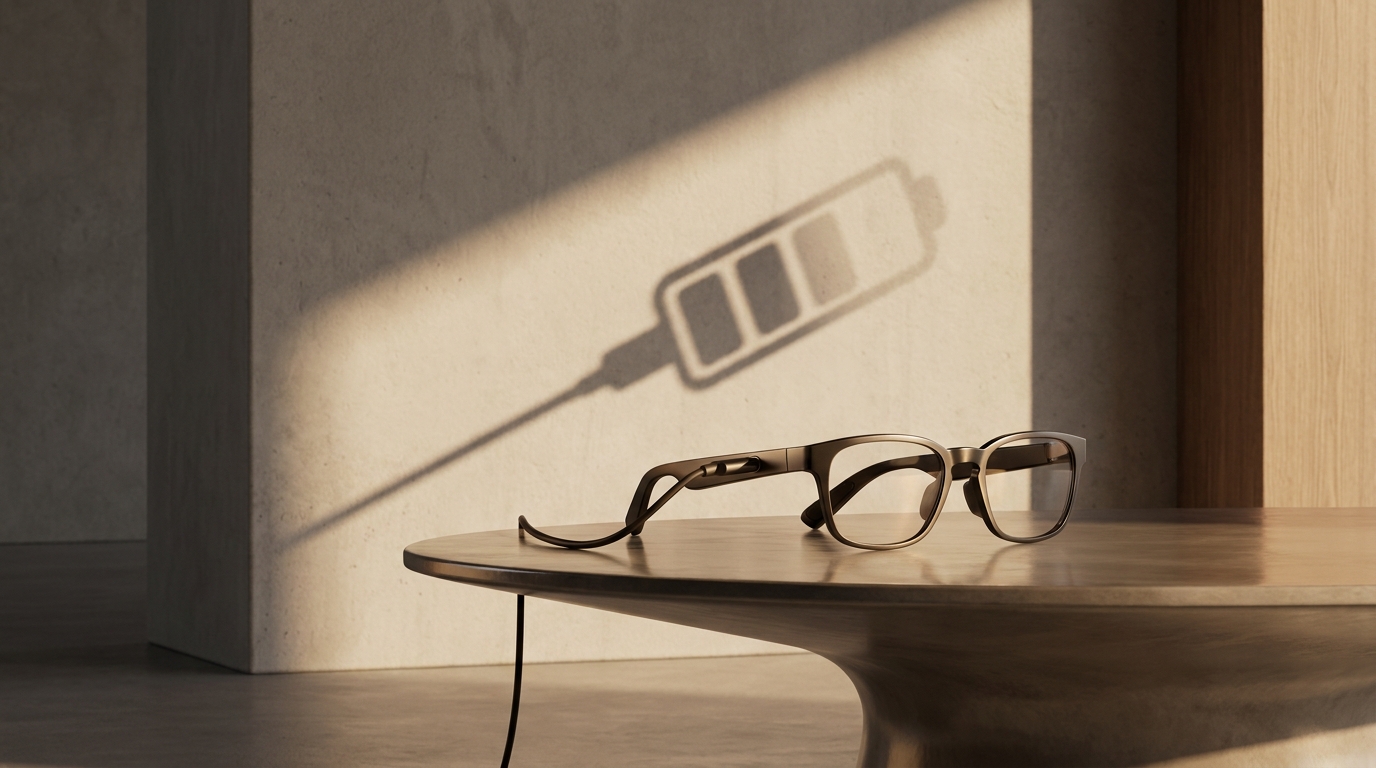
The year 2026 has been heralded as the tipping point for smart glasses, a moment when AI-first eyewear moves beyond niche tech to legitimate, mainstream adoption. Optimistic reports trumpet everything from soaring Ray-Ban Meta sales to Google's Android XR taking the lead in an AI revolution. Yet, beneath the surface of this perceived shift, the smart eyewear industry continues to overlook a critical, paralyzing flaw: the battery problem that nobody is solving.
We at Smart Glasses Daily have consistently argued that omnipresent AI intelligence is the true path forward for smart eyewear. Google's strategic positioning of Android XR and Samsung's imminent entry into the market with Android XR-powered devices reinforce this vision. But how can intelligence be truly 'omnipresent' if the devices enabling it die within hours, constantly tethering users to a charger?
The industry's historical fixation on augmented reality (AR) displays is a primary culprit, creating an 'infinite loop' of power demands. Companies like Meta and Apple have poured billions into hardware form factors and display technologies, chasing a 'screen obsession' that consistently drains batteries. This display-first approach, as we have long contended, is a dead end for true 'always-on' AI.
Even as the market shifts towards AI assistants taking over eyewear, moving past the visual spectacle of AR, the underlying power demands remain formidable. Whether it is real-time processing for an AI assistant or discreet recording for user utility, every feature consumes energy. The promise of ubiquitous intelligence is hollow without a sustained power source.
Consider Samsung's upcoming smart glasses, tipped for a July 22 Galaxy Unpacked debut, running Google's Android XR. While exciting for its open ecosystem and AI-first approach, the core question persists: what about the battery life? If Samsung's initial offering, or any Android XR device, cannot provide multi-day usage, its 'omnipresence' will be fleeting at best.
The privacy concerns surrounding smart glasses, highlighted by incidents like the British woman unknowingly filmed and extorted, are deeply troubling. While the focus is rightly on ethics and consent, the very 'discreetness' of these devices contributes to their limited battery capacity. If smart glasses could last for days, they might need to be bulkier, making their recording capabilities more obvious and, perhaps, less exploitable.
Even specialized accessibility tools, like the live-captioning glasses from Even Realities, face this challenge. While they prioritize text legibility and often omit power-hungry features, the continuous real-time transcription of conversations is still a significant processing load. The utility of such critical aids is severely limited if they cannot reliably last for an entire day's activities.
Snap's developer bootcamp for Spectacles, focusing on 'sophisticated AR experiences,' also risks falling into this power trap. Advancing augmented reality, sparse mapping, and AI-native Lens development inherently demands substantial computational power. Without a commensurate leap in battery technology, these sophisticated experiences will remain short-lived novelties.
The 'silent war' between Western companies focused on displays and ecosystems, and China's AI giants integrating formidable AI directly into eyewear, still grapples with the same physics. While Chinese powerhouses like Baidu avoid the 'screen obsession,' sustained, sophisticated AI processing, regardless of its visual output, remains energy-intensive.
The notion that smart glasses hit the mainstream in 2026, as asserted by multiple reports, must be critically examined through the lens of battery performance. Ray-Ban Meta sales might have tripled, and new players like Even Realities made waves with their discreet G2 smart glasses, but user experience hinges on reliability. A device that constantly needs charging is inherently unreliable for 'everyday users'.
School districts, like Clarksville-Montgomery County, are already eyeing bans on student smart glasses due to privacy concerns. These institutional responses signal a societal hesitance that will only deepen if smart glasses are perceived as both invasive and unreliable. A perpetually dying device undermines trust and adoption, regardless of its AI prowess.
The industry's current trajectory promises facial computing and always-on AI, but the reality for users is often a device constantly tethered to a charger. This 'dead battery' problem is a fundamental flaw preventing the ubiquitous, always-on AI that many brands envision and market. It is not merely an inconvenience, but a direct contradiction to the very promise of 'omnipresent intelligence'.
No major brand is publicly touting a breakthrough in battery technology or a paradigm shift in power management specifically for the smart eyewear form factor. The focus remains on software, ecosystems, or incrementally better displays. Until a fundamental solution to power density and efficiency emerges, the mainstream future of smart glasses, and their truly 'always-on' AI, remains an aspiration, not a reality.
The smart glasses revolution will only be truly realized when devices can sustain their promised intelligence without constant external power. Until then, the industry risks creating a future of perpetually dying devices, limiting 'omnipresent' AI to aspirational marketing rather than everyday utility.
Interactive guide — prices, displays, cameras, battery.
Share this story