Reviews · Inmo
Inmo Go 3 Review: Functional AR Glasses for Daily Productivity, Priced Right
The Inmo Go 3 brings AI-powered features like live translation and smart recording to an affordable AR eyewear package. We assess if its modular design and 40-hour battery life live up to daily demands.

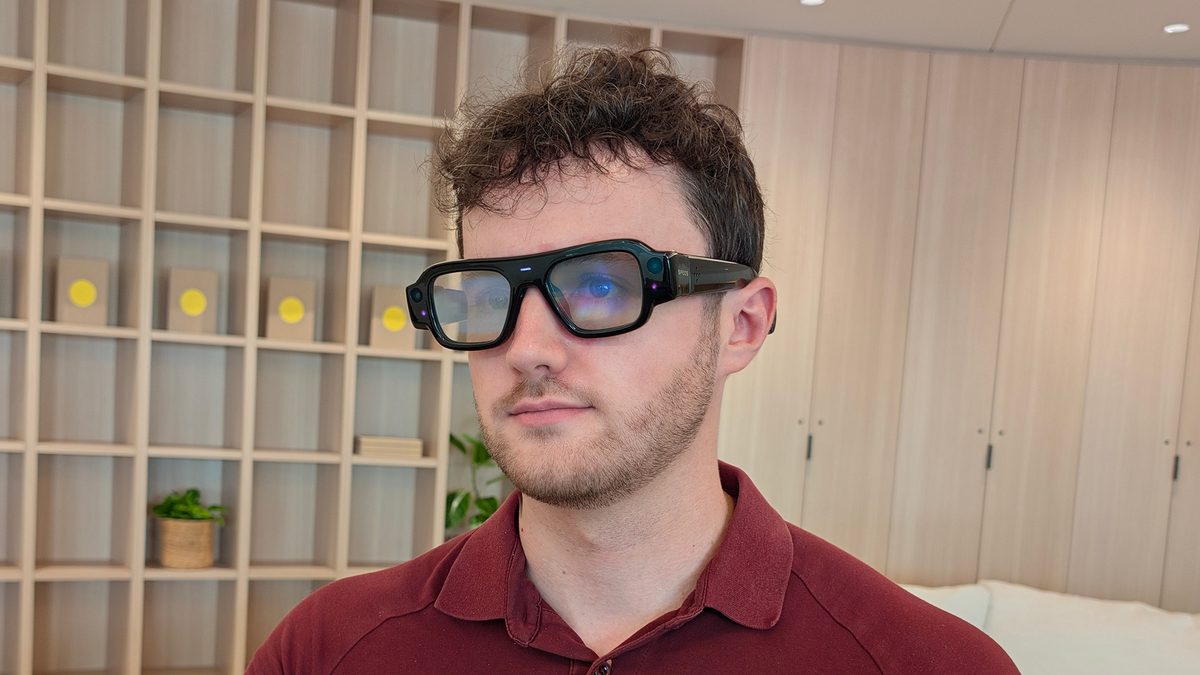
Geeky Gadgets' Steven Sullivan recently put the Inmo Go 3 smart glasses through a week of intensive real-world use. The $450 AR glasses, announced May 2, 2026, feature dual monochrome micro-LED displays capable of 1,500 nits brightness, ensuring visibility even in direct sunlight. A modular battery system, swappable batteries, and a charging case extend usage up to 40 hours.
Sullivan's review highlights the Inmo Go 3's core functionalities: real-time translation across 98 languages, smart recording with AI summaries and notes, and live subtitles. These features aim to integrate AR's utility into both professional tasks and casual activities. Navigation is handled via a touch control ring, and audio is delivered through a magnetic clip-on speaker.
The glasses weigh a mere 58 grams, prioritizing comfort during extended wear. Geeky Gadgets notes their balanced design and discreet aesthetic, suitable for various settings. Adjustable nose pads and four frame styles, including prescription options, cater to diverse users. The 30-degree field of view is standard for this class of device.
Battery life, often a bottleneck for wearables, is addressed through the Inmo Go 3's modular system. Each 270mAh battery offers around 5 hours of operation, with the 1,300mAh charging case pushing total usage to 40 hours. USB-C charging ensures convenience, and the swappable battery design minimizes downtime.
Beyond translation and recording, the Inmo Go 3 offers music playback, customizable notifications, and teleprompter functionality. Pricing ranges from $450 to $550, depending on accessory bundles that include the touch control ring and clip-on speaker.
Our take: The Inmo Go 3 targets a sweet spot. Instead of chasing full-color AR, Inmo opted for monochrome displays, which significantly impacts power efficiency and cost. The emphasis on practical AI features like translation, summarization, and live captions positions it as a genuine productivity tool rather than solely an entertainment device. The modular battery system is a smart strategic move, differentiating it from competitors that often struggle with single-charge endurance. At $450, it is an accessible entry point for those seeking functional AR without breaking the bank.
## Design and earlier context
The emphasis on balancing everyday aesthetics with lightweight hardware has been central to INMO's vision for this generation. As we reported on April 2, 2026, ahead of the device's retail launch, the GO3 was introduced as setting a new standard for everyday AI smart glasses. That initial reveal outlined an ultralight design, swappable batteries, and everyday AI capabilities created to integrate seamlessly into ordinary routines.
By choosing monochrome micro-LED optics rated at 1,500 nits rather than heavier full-color projection systems, INMO managed to keep the total frame weight at 58 grams. This approach was engineered to deliver sunlight visibility and long sessions of live subtitles or teleprompter readouts without the physical bulk typically associated with head-mounted optical displays.
## Campaign launch and competitive landscape
Since this article was published in May 2026, INMO has steadily expanded the GO3 ecosystem. Update: As we reported on June 12, 2026, the INMO GO3 AI glasses launched on Kickstarter, showcasing real-time two-way translation, photo translation, and augmented reality navigation. That campaign also detailed integration with leading artificial intelligence engines, including ChatGPT and Gemini, to power enhanced utility across text and voice processing.
Update: International attention followed later in the year. As we reported on September 16, 2026, the INMO GO3 received an IFA Innovation Award for its real-time, binocular translation across 98 languages. That industry recognition positioned INMO against other key players in a fast-moving autumn market, including Meta, Rokid, and Even Realities.
## Product line developments and safety updates
Update: While the GO3 expanded its profile, INMO had to navigate product challenges elsewhere in its portfolio. As we reported on September 26, 2026, INMO issued an urgent recall for its Air3 smart video glasses across the United States and Canada. Regulators and the company advised owners to stop using the Air3 immediately after finding that overheating temples created a burn hazard on the left side of the frame.
Update: Despite the Air3 recall, INMO moved forward with the GO3 platform. As we reported on October 22, 2026, the INMO GO3 smart glasses officially debuted following an announcement on October 21. That release emphasized the model's dual MicroLED displays, integrated Gemini AI, and swappable power system as INMO's primary response to endurance and usability challenges across the consumer smart glasses segment.
Interactive guide: prices, displays, cameras, battery.
Share this story