Analysis · —
The Infinite Loophole: Smart Eyewear is Chasing AI Dreams on a Dead Battery
While the smart glasses industry fixates on everything from camera-equipped AirPods to gesture controls, a critical flaw persists: no one is tackling the battery problem essential for truly ubiquitous, always-on AI.
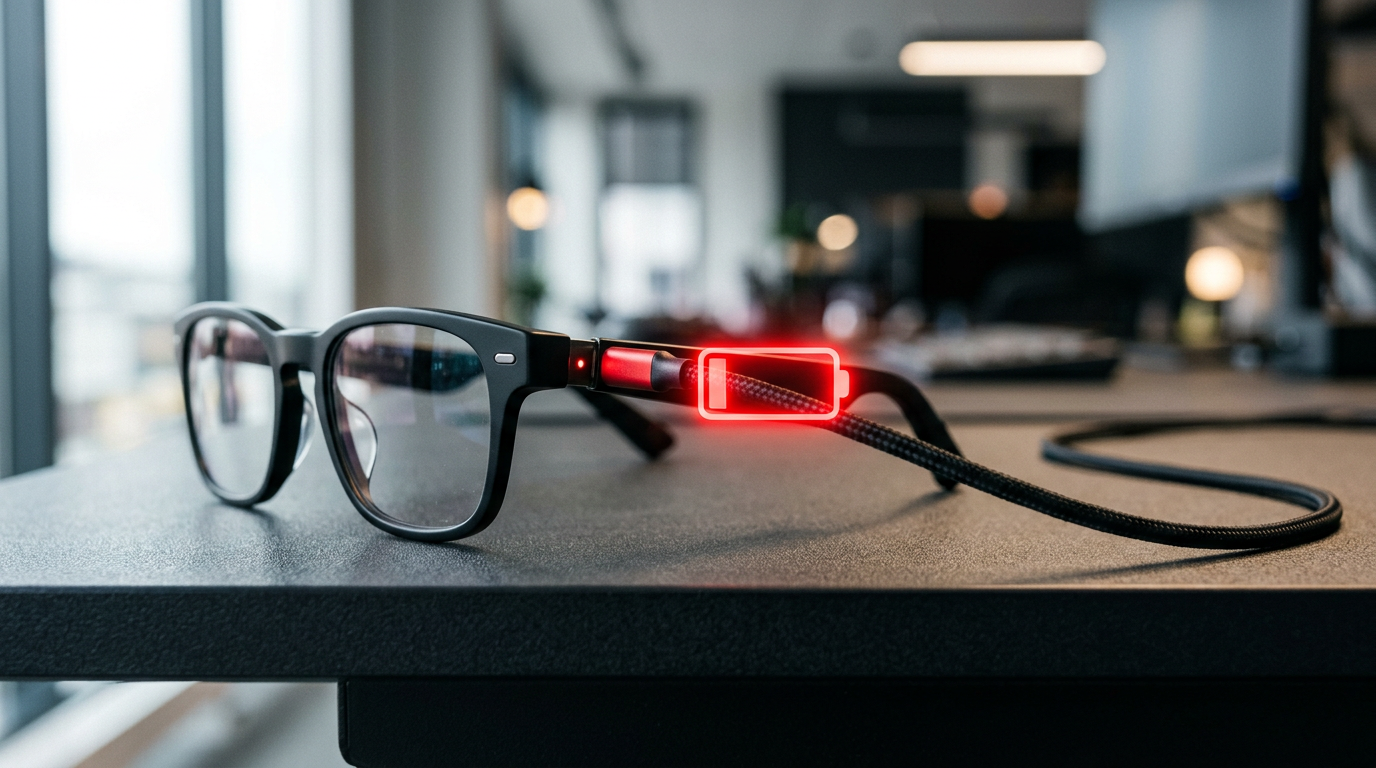
The smart glasses market is a masterclass in distraction. Every other headline touts a new AI breakthrough, a sleeker design, or a 'meta-killer' feature, yet the fundamental constraint - power - remains stubbornly unaddressed. Companies are promising always-on facial computing, but the reality is a user experience constantly tethered to a charger.
Take Apple, for instance. We've written about their rumored camera-equipped AirPods, poised to detonate Meta's lead by embedding AI vision into a device people actually wear. The intelligence suggests these devices, alongside Apple's display-less AI glasses, will prioritize advanced gesture controls and dual cameras, signaling a strategic move towards lightweight, less power-hungry design.
However, 'less power-hungry' is not 'power self-sufficient.' Apple’s strategy, like many others, seems to be to incrementally reduce demand rather than radically solve supply. Even their Vision Pro, lauded for its spatial computing, is notorious for its external battery pack - a compromise that instantly undermines the promise of seamless integration.
Meta, despite Mark Zuckerberg's bold prediction that "most glasses that people wear aren't AI glasses" in a few years, faces the same fundamental challenge. Their Ray-Ban AI glasses, while normalizing face-worn tech with millions of units sold, are still limited by their meager battery life. The moment their AI capabilities are truly pushed, the battery icon flashes, effectively crippling the 'always-on' promise.
This isn't just about consumer devices. Even the industrial-focused Even Realities G2, with its "Terminal Mode" for monitoring AI coding agents, requires sustained power for continuous oversight. The vision of coders untethered from their desks, constantly connected to their digital assistants, relies on a power source that doesn't currently exist in a truly wearable form factor.
Baidu, entering the fray with its Xiaodu AI Glasses, touts seamless, AI-powered assistance, but their core competency in AI doesn't magically circumvent physics. Their promise of extending AI directly to our line of sight is compelling, but the execution will inevitably hit the battery wall, just like everyone else.
The industry's obsession with display-less designs, as we've argued, is a clever workaround for battery drains. Apple's rumored AI glasses and devices like Baidu's Xiaodu prioritize invisible AI over flashy AR displays, primarily to conserve power and enhance wearability. But this 'strategic simplicity' only postpones the inevitable reckoning with power demands.
While The Verge continues to lament the lack of a "killer app" despite advancements in design and affordability, the real killer is the battery. It doesn't matter how innovative the AI is, or how sleek the design, if the device dies halfway through your workday.
The Inmo Go 3 review highlighted a crucial differentiator: a modular battery system with swappable batteries, extending usage up to 40 hours. This is a pragmatic, if not revolutionary, approach to mitigating the problem, acknowledging that continuous usage demands more than a single charge can provide.
Dogs Inc. leveraging AI glasses for enhanced vision support for individuals with vision loss is a powerful application, but the efficacy of this assistive technology hinges on consistent operation. A tool that provides independence cannot sporadically fail due to power constraints; reliability is paramount.
The dirty secret is that the current crop of smart glasses, for all their AI prowess and discreet cameras, are built on a fundamentally unsustainable power model. They promise a constant digital companion, a perpetual eye on the world, but deliver a device that needs regular, inconvenient recharging.
Until a paradigm shift in battery technology or energy harvesting occurs, the smart eyewear market will remain stuck in this infinite loop. We'll continue to see impressive AI advancements, sleek form factors, and revolutionary use cases, all undercut by the same, unsolved problem: keeping the damn things powered.
The true 'killer app' isn't a new feature; it's a battery that can keep pace with the ambitions of AI. Until then, every "always-on" promise is just marketing fluff, and every groundbreaking device is a few hours away from becoming an expensive paperweight.
The industry needs to stop dancing around the edges and invest in fundamental power solutions, not just incremental efficiencies. Otherwise, the vision for ubiquitous, AI-powered eyewear will remain just that: a vision.
Interactive guide — prices, displays, cameras, battery.
Share this story