Smart Glasses Daily

深度分析 · · (English original)

The Unseen Revolution: Why HUD-Only Smart Glasses Are Back

While tech giants fight an AI war in your ear, a quieter rebellion is putting data back in your eye. The humble heads-up display is making a comeback, betting that seeing is better than hearing.

S. WHITMAN· American 特派记者·2026年4月23日·5 分钟阅读
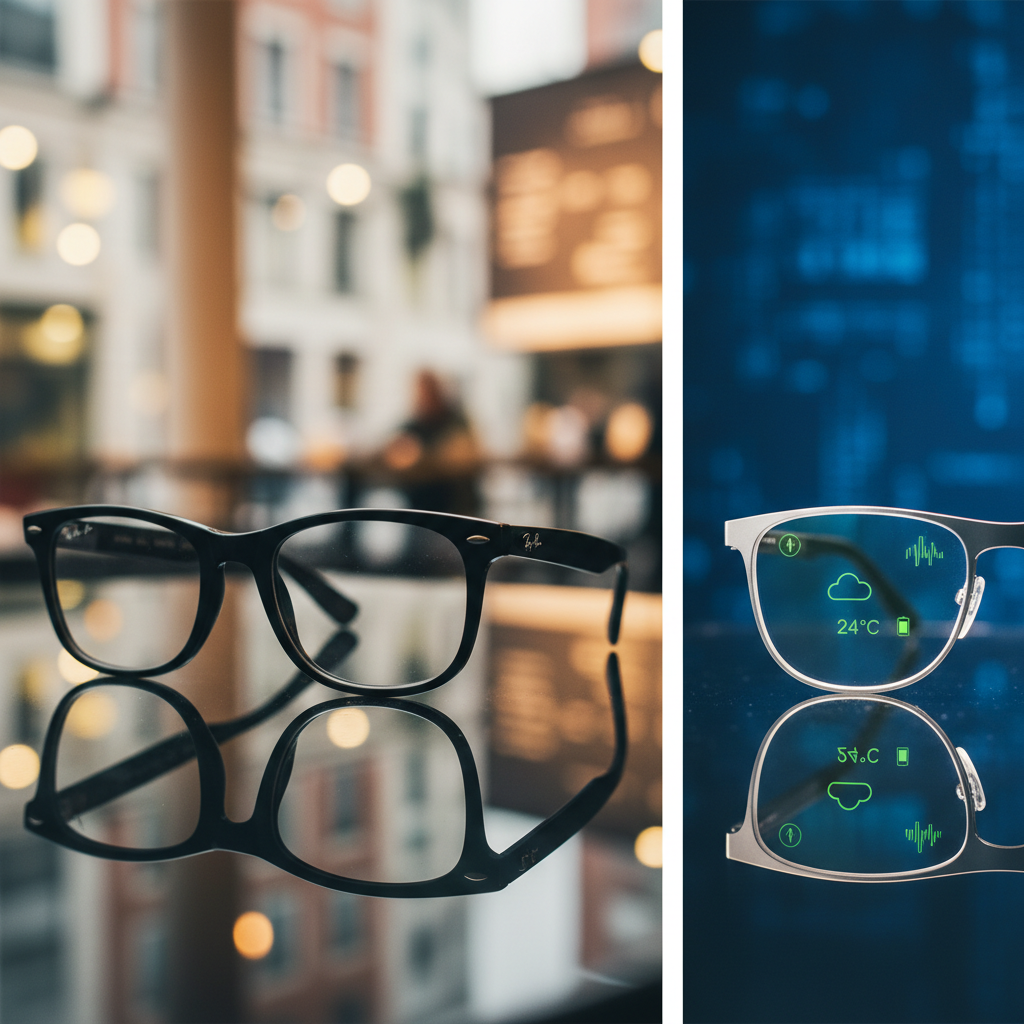
A split image showing stylish Ray-Ban Meta glasses on one side and the minimalist HUD of Brilliant Labs' Frame glasses on the other.

A split image showing stylish Ray-Ban Meta glasses on one side and the minimalist HUD of Brilliant Labs' Frame glasses on the other.

Let’s get one thing straight: the debate over whether people will wear a computer on their face is over. The retail success of the Ray-Ban Meta collaboration proved that if you nail the form factor and partner with a cultural titan, consumers will sign up. The battle lines for the next phase seem equally clear, with a brutal race between Meta, Apple, Google, and now Alibaba to own the always-on AI assistant that lives inside the frame. The accepted wisdom is that the future of smart glasses is a voice in your ear, not a screen in your eye.

This screen-less, AI-first strategy is a masterclass in market normalization. As Ray-Ban’s own brand guide makes plain, the play is about style, not screens. The result, as WIRED admits, are “some of the nicest glasses I’ve ever worn.” This approach, now being mirrored by fast-followers like Huawei, cleverly sidesteps the social awkwardness and technical complexity of visual displays. It’s a face computer that’s primarily a set of headphones and a camera, with a cheerful AI ready to misidentify flora on your walk.

But this audio-centric model, for all its commercial brilliance, feels like a deliberate compromise—a computer that has voluntarily hobbled its primary output channel. It outsources its intelligence to your ears, turning a potentially powerful visual tool into a prettier, more expensive set of AirPods. While the giants wage a multi-billion-dollar war over whose LLM will whisper sweet nothings about your incoming texts, they are ignoring the immense, untapped potential of putting simple, useful light directly into your field of view.

Just as the market seems to have consolidated around this single idea, a silent comeback is underway. A handful of focused, opinionated startups are reviving the forgotten category of heads-up display (HUD) glasses. Companies like Brilliant Labs with its open-source Frame, and the stealthier Even Realities, are betting against the AI chatbot gold rush. Their thesis is that a small, non-intrusive display is profoundly more useful than a disembodied voice.

This isn't the clunky, all-encompassing augmented reality that has been promised—and has failed to deliver—for a decade. This is something far more practical: a smartwatch for your vision. Think glanceable notifications, turn-by-turn directions that float in your path, live translation subtitles, or the name of the person calling you. It’s about augmenting the user with critical data, not overwhelming them with a digital world or a conversation they have to manage.

If you need proof of the raw, unadulterated utility of a HUD, look no further than its most dystopian application. According to recent reports from Ken Klippenstein, the Department of Homeland Security is developing “ICE Glasses” to give agents real-time biometric identification capabilities. This is the ultimate task-specific wearable: it’s not for playing music or capturing moments, it’s for overlaying critical, actionable data onto reality. It’s a chilling but powerful validation of the core concept.

The re-emergence of consumer HUDs is happening now because the market, despite Meta’s lead, is still a “messy, fragmented, and opportunistic” landscape. Before the prophesied “Android XR invasion” turns everything into a full-blown platform war, there is a window for alternative ideas to find a product-market fit. While Google and Samsung plot to counter Meta, and Alibaba weaponizes its Qwen LLM, these smaller players are quietly building for a user who wants information, not just conversation.

Of course, the ghost of Google Glass looms large over any device that puts a display near the eye. But this new wave is learning from the past. They are de-emphasizing or removing the camera to shed the 'glasshole' stigma. They are focusing on lighter, more elegant hardware and, in the case of Brilliant Labs, leaning into an open-source ethos that stands in stark contrast to the closed ecosystems of Meta and Apple.

The control problem, which has persistently plagued AR and contributed to its failure, is also being addressed from new angles. While a company like Sensoryx bets on an external ring to finally fix AR input, the beauty of the minimalist HUD is its simplicity. With a more limited and focused set of functions, the need for complex gesture controls or clumsy on-frame touchpads diminishes significantly. The goal isn't to control a spatial computer, but to receive a timely piece of information.

What’s taking shape is a fundamental philosophical divide about the future of personal computing. The path laid out by Meta, Ray-Ban, and their followers is one of passive mediation, where an AI assistant becomes the primary interface for your life. The HUD-only path is one of active augmentation, providing data directly to the user and trusting them to make their own decisions. It’s the difference between being told where to turn and seeing the path for yourself.

The noise from Silicon Valley and Shenzhen is deafening, all centered on a costly war for AI supremacy. The prevailing strategy is to sell you a stylish accessory that talks to you. But the quiet resurgence of the heads-up display is a compelling counterargument. It’s a sharp, focused bet that what we truly want from our glasses isn’t another voice in our ear, but a little bit of useful light in our eye.

每周简报

智能眼镜资讯,每周五直送邮箱。.

每周五清晨一封简报。无废话。一键退订。

我们绝不会分享您的邮箱。

相关文章

一张佩戴时尚智能眼镜的人的特写镜头,一个微弱发光的数字大脑图形叠加在镜片上,代表内在的AI助手。

Analysis

您的眼镜即将迎来“机器幽灵”

智能眼镜之战不再关乎摄像头或款式。这是一场Meta、Apple和Google之间残酷的竞争,旨在掌控您脸上的全天候AI助手。

W. CHEN·5 min read

Apr 22, 2026

一名联邦特工佩戴智能眼镜

Analysis

国土安全部的“ICE眼镜”:一个新的监控担忧时代

据报道,美国国土安全部正在为联邦特工开发智能眼镜,旨在利用生物识别数据实时识别个人。这项技术不仅对目标群体,而且对所有美国公民都构成了重大的隐私担忧。

J. MARCHAND·2 min read

Apr 22, 2026

讨论焦点

热议

本周空间计算领域最具争议的文章。

为你精选

为你推荐

从评测、新闻与分析中精选,你可能错过的内容。