Guides · Sensoryx
Sensoryx: The Swiss Bet on a Magic Ring to Finally Fix AR
For years, controlling AR glasses has been a clumsy affair of taps, swipes, and awkward gestures. A Swiss upstart believes the answer is a high-precision ring that could finally make spatial computing feel natural.
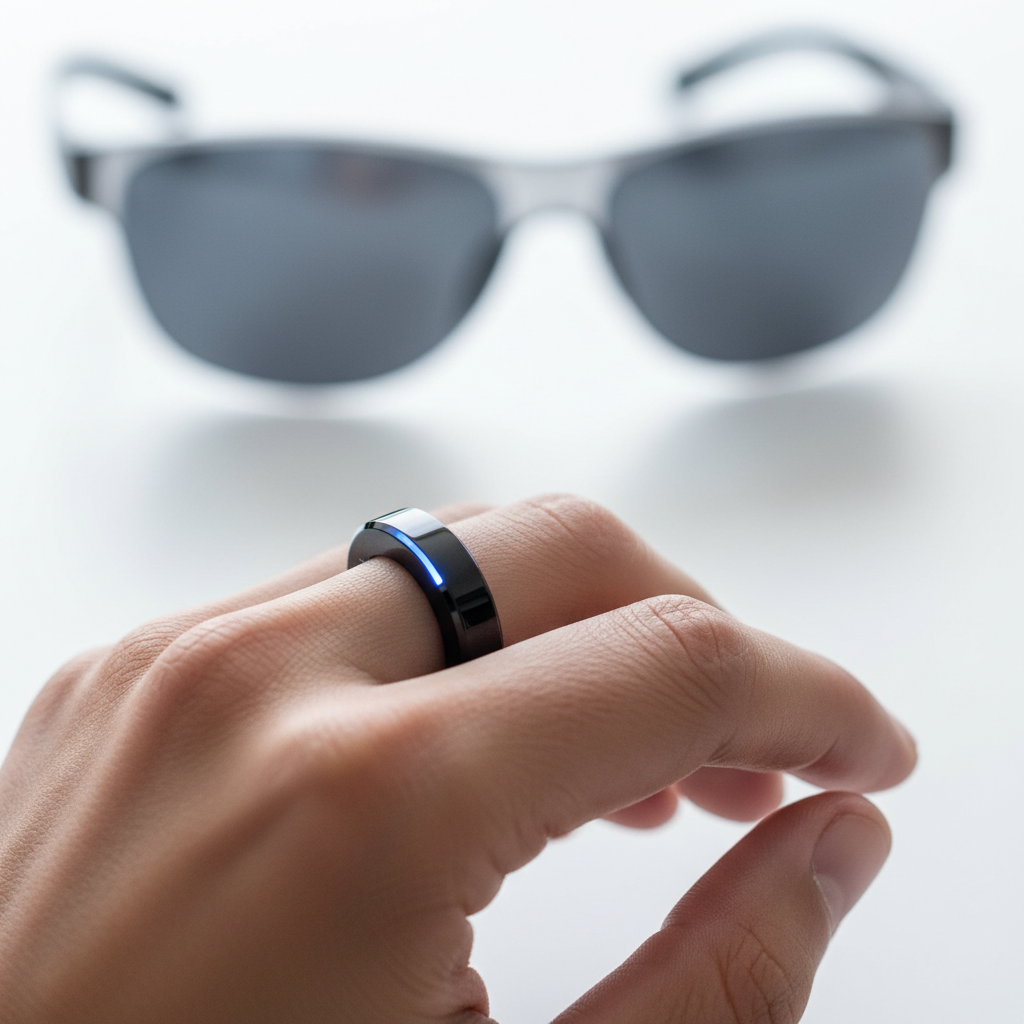
Every few years, a company emerges from stealth with a deceptively simple solution to a problem everyone else has been overcomplicating. In the world of smart glasses, where interacting with digital content remains a frustrating mess, that company might just be Sensoryx. While giants pour billions into AI assistants and eye-tracking, this Swiss firm is betting the farm on a finger-worn ring.
Make no mistake: the input problem is the single biggest barrier to mainstream AR adoption. Clumsy on-frame touchpads, unreliable hand-tracking, and socially awkward voice commands have all failed to deliver the seamless control that spatial computing promises. Sensoryx's thesis is that the solution isn't to cram more tech into the glasses, but to externalize control to a dedicated, hyper-accurate device.
At first blush, Sensoryx looks like another specialized European engineering firm, emerging from the high-tech corridors of Switzerland with a focus on precision tracking. The company's history is not in consumer electronics, but in foundational R&D for motion capture and spatial sensing. This background is critical; they are not a fashion brand dabbling in tech, but a team of engineers obsessed with sub-millimeter accuracy.
Their target is laser-focused: the nascent but high-value AR glasses market. They are not competing in the simpler smart audio segment. Instead, Sensoryx is tackling the most complex challenge head-on: creating a robust, intuitive control scheme for true augmented reality. Their arrival comes as the industry is desperate for a 'mouse moment'-an input standard that can unlock the PC-like potential of AR.
The 'why now' is clear. As AR hardware from competitors begins to mature in display quality and processing power, the user interface remains the wild west. Sensoryx is entering the fray not with a 'me too' pair of glasses, but with what it claims is the missing link: a control system that just works.
The centerpiece of the Sensoryx strategy is a product we have tested in prototype: the Magic Ring. This isn't a simple button-pusher. Based on our hands-on time, it’s a sophisticated spatial input device capable of tracking micro-gestures with extraordinary precision. The company claims sub-millimeter accuracy, and our experience bears that out. Pointing, selecting, and manipulating virtual objects feels less like a gimmick and more like a direct extension of your intent.
Details on the ring's all-day battery life and discreet form factor suggest Sensoryx understands the practical demands of an always-on wearable. The ability to control a complex spatial interface with subtle, almost invisible, finger and hand movements is a genuine breakthrough, moving past the theatrical gestures current systems demand.
What about the glasses themselves? As of now, Sensoryx has not publicly announced a specific headset. This is the biggest question mark hanging over the brand. It is unclear whether the company plans to release its own fully integrated smart glasses or position the Magic Ring as a premium, must-have accessory for other manufacturers' products. For now, Sensoryx is selling a solution, not just a spec sheet.
Against Google's sprawling ambitions with Android XR and Project Astra, Sensoryx appears almost quaint. But that’s its strength. While Google is building a massive, all-encompassing software ecosystem, Sensoryx is solving a singular, critical hardware problem. An 'Android for AR' is useless if you can't reliably click on anything. Sensoryx provides a potential answer to that fundamental UX challenge, one that Google's own hardware will inevitably face.
Compared to a hardware-first player like TCL RayNeo, the differentiation is even starker. TCL excels at producing affordable, high-quality display-centric glasses like the RayNeo Air 3s. Their weakness, however, is the user interface. One could easily imagine a future where the best-in-class AR system is a TCL display paired with a Sensoryx ring-positioning the Swiss company as an essential component supplier, akin to Dolby in audio or Zeiss in optics.
Finally, stacked against Huawei's audio-focused Eyewear, Sensoryx is playing a different game entirely. Huawei is successfully merging prescription eyewear with open-ear headphones for calls and music. Sensoryx, in contrast, is committed to the far more ambitious goal of interactive, visual augmented reality. They are not in the same category; Huawei is an accessory, while Sensoryx is building a new computing interface.
So, who is Sensoryx for right now? It's for the developers, prosumers, and enterprise users who have been wrestling with the broken promise of AR interaction for years. The Magic Ring is a tool for builders and power users, offering a level of control that simply doesn't exist elsewhere.
The company's primary strength is its deep, focused expertise in a critical niche. Its primary weakness is its complete lack of a proven consumer product or ecosystem. The reliance on a separate, physical ring is also a hurdle; losing it means your expensive glasses lose their magic. Over the next 12 months, the world will be watching for one thing: the glasses. Whether Sensoryx launches its own headset or announces a major partnership with an established manufacturer will determine if this intriguing technology can become a true market force.
Interactive guide — prices, displays, cameras, battery.
Share this story