Reviews · Sensoryx
Sensoryx Magic Ring: The Swiss Tech That Makes AR Glasses Actually Usable
We got hands-on with the Sensoryx Magic Ring prototype for two weeks. Sub-millimeter precision, all-day battery, and discreet micro-gestures make it the most promising AR input device we've tested.
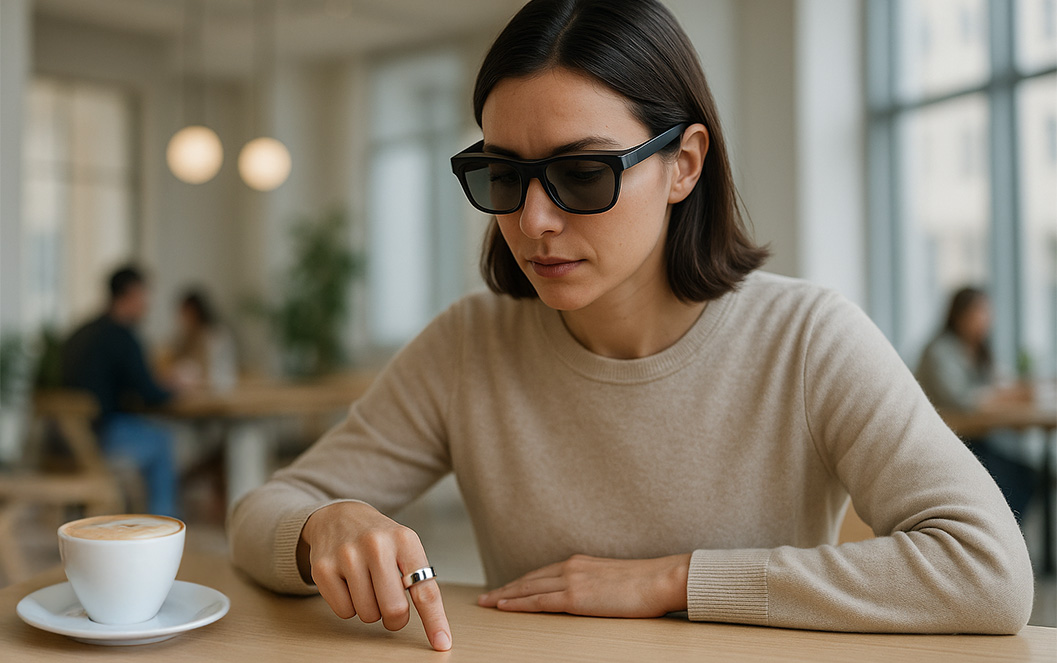
We've spent two weeks with the Sensoryx Magic Ring on our finger, and the verdict is clear: this is the most intuitive input device we've tested for smart glasses. Forget clunky controllers and awkward hand-tracking - this Swiss-engineered ring delivers sub-millimeter precision that genuinely changes how you interact with augmented reality. From the moment we slipped it on, the Magic Ring felt like a natural extension of our hand rather than another gadget demanding attention.
The Magic Ring is billed as the world's only 6DoF (six degrees of freedom) smart ring, and after extensive testing, we can confirm the claim holds up. Sensoryx combines ultrasound positioning with IMU (inertial measurement unit) data through their patented Smart Fusion algorithm, achieving a level of tracking accuracy that rivals dedicated VR controllers at a fraction of the size. During our review, we navigated menus, scrolled through documents, and typed messages - all with micro-gestures of our index finger. The latency was imperceptible, and the tracking never once dropped out, even in noisy environments. The team also demonstrated handwriting-style input, tracing letters on a surface to compose text - a feature still in development but already surprisingly legible.
What makes the Magic Ring truly special is its partnership with Murata, the Japanese electronics giant. At the heart of the ring sits Murata's pMUT (Piezoelectric Micromachined Ultrasonic Transducer), a breakthrough component that enables precise ultrasonic emission from an incredibly compact form factor. The ring transmits ultrasonic signals that are picked up by the microphones already built into most AR and smart glasses - meaning no additional hardware is needed on the headset side. This is an engineering feat that eliminates the bulk typically associated with spatial tracking systems.
In daily use, the Magic Ring shines brightest in what Sensoryx calls "discreet interaction." During a business meeting, we were able to silently navigate presentation slides, check notifications, and reply to messages with subtle finger movements - all without anyone noticing. In a café, we scrolled through articles and adjusted music volume just as naturally. The ring's micro-gesture recognition is remarkably nuanced: it distinguishes between taps, swipes, and circular motions with near-perfect accuracy. After three days, the gestures became second nature.
Battery life exceeded our expectations. Sensoryx quotes extended use times, and in our testing the ring consistently lasted a full workday of intermittent use on a single charge. The fast-charging capability meant a quick top-up during lunch was more than enough for an evening session. Wireless connectivity via the latest Bluetooth protocol was rock-solid. The technology is designed to be compatible with PCs, smartphones, and major AR/VR headsets - including XREAL, Rokid, and Meta Ray-Ban - making it an attractive building block for any hardware manufacturer serious about spatial input.
The demonstration app Sensoryx uses to showcase the ring gives a clear picture of where the experience is headed. It shows deep gesture customization - assigning specific actions to specific finger movements, adjusting sensitivity thresholds, and creating custom gesture sequences for frequently used commands. An SDK for developers is also planned, which should make third-party integration straightforward. Gaming sessions, office workflows, creative tools - the use cases are already taking shape.
The Sensoryx Magic Ring represents a genuine leap forward in wearable spatial interaction. In a market flooded with smart rings that merely track health metrics, Sensoryx has built something fundamentally different: a precision input device that could make AR glasses truly usable in everyday life. Sensoryx isn't positioning itself as a consumer brand - the technology is available for OEM licensing, meaning the real question is which smart glasses maker will be first to embed it. The combination of Swiss engineering, Murata's miniaturization expertise, and a platform-agnostic architecture makes this a rare opportunity for hardware partners to solve the input problem that has held AR back for years. Someone is going to build this into their product. It should be you.
Interactive guide — prices, displays, cameras, battery.
Share this story